

Christmas (December 25) is the central festival of the Holy Nights. It is the night the light is born again in the deepest dark. In a Waldorf home, Christmas is brought slowly across the four Advent weeks and held tenderly on Christmas Eve, with the lit tree, the nativity, the carols, and the family meal. This guide brings together the nativity story, the hour-by-hour rhythm of Christmas Eve and Day, recipes including Sophie’s St Lucia buns, crafts, songs, and age-appropriate ways to bring each part to life with your children.
The Meaning of the Festival
As the seasons shift, bringing colder days and longer nights in the Northern Hemisphere or warmth and the height of summer in the Southern Hemisphere, the Advent and Christmas season invites us to pause, reflect, and celebrate the light within. This time of year is one of anticipation and preparation, both outwardly, through decorating, baking, and crafting, and inwardly, as we cultivate patience, generosity, and reverence.
As Christmas draws near, we celebrate the light within, kindness, love, and the giving spirit that shines brightly whether in the winter’s darkness or the summer’s radiance. Whether through stories, songs, candlelight, or simple handmade gifts, this season is a reminder of hope, renewal, and the magic of giving.
The celebration of Advent does have Christian origins. However, it can be broadly enjoyed as a way of marking the approaching Christmas holiday and giving space to the anticipation with a meaningful, beautiful celebration. In a Waldorf approach, the most cosmic of all festivals is also the most tenderly human. At Christmas, the vast becomes small enough to hold.
The Nativity Story
Long ago, in a small town in a far country, a young woman named Mary and her husband Joseph set out on a long journey. Mary was carrying a child, and the road to Bethlehem was dusty and cold. When they arrived at last, the town was full. House after house, the answer was the same. There was no room.
At the edge of town, a kind innkeeper showed them to his stable, where the ox and the donkey stood quietly in the straw. There, in the soft warmth of the animals’ breath, Mary’s child was born. She wrapped him in cloths and laid him in the manger.
Out on the hillside, shepherds were watching their sheep when the sky filled with light. An angel spoke of a child, and a great choir sang. High above, a single star shone over the stable, guiding all who would come.
For the Southern Hemisphere
Christmas keeps its date across the world, and the nativity, the star, and the carols travel easily into a summer night. In the Southern Hemisphere, the old Northern images of deep cold, short days, and candles against darkness do not match what the children see out of the window. The festival still holds, but its mood is warmth and long light rather than hush and dark.
A few small shifts usually do the work. The tree, if fresh evergreen is hard to find, can be a potted native. Candles on the tree are replaced by a single candle at the table to keep the flame-image alive in a warm room. The Christmas Eve walk is a walk at dusk rather than in the cold. The meal may move outside, under the garden table, with stone fruit and seasonal produce alongside whatever family dishes you keep. St Lucia buns and saffron still belong to December 13, though you are more likely to eat them in the cool of the morning than by lantern.
What remains the same is the heart: the empty manger waiting across Advent, the youngest child laying the Christ child in on Christmas Eve, the carols sung together, the pause in the hurry of the world. The hour-by-hour rhythm below is written for a Northern winter but adapts gracefully. Take what fits your family, your climate, and your faith, and let the rest go.
The Four Advent Weeks and Christmas Week
Across the four Advent weeks, the garden table on the nature shelf has slowly come to life. Week one, the mineral kingdom: stones, crystals, a little cave of moss. Week two, the plant kingdom: pine, holly, dried roses, a small fir. Week three, the animal kingdom: wooden sheep, the donkey, the ox, birds in the branches. Week four, the human kingdom: the shepherds appear, then Mary and Joseph begin their long walk along the windowsill, moving a little closer each day.
Christmas week itself has its own small rhythm.
Dec 22 or 23. The tree is brought into the house. In many Waldorf families it stays in a cool room or hallway, undecorated, until Christmas Eve, so that the lit tree on the night itself is a true surprise.
Dec 13, St Lucia Day. In the Nordic tradition, St Lucia Day marks the opening of the Christmas season. Saffron-golden St Lucia buns (Saffransbullar) are baked to symbolise light carried into the darkness of winter. See the recipe below.
Dec 23 or 24 morning. Christmas bread is baked. The kitchen smells of cardamom and orange peel. Children shape little wreaths or stars from the dough.
Dec 24 afternoon. The nativity arrives at the stable on the garden table. Mary and Joseph have walked all of Advent and have come home. The crib is still empty. The child will be laid in tonight.
Dec 24 evening. Christmas Eve. Everything has led to this hour.
Christmas Eve, Hour by Hour
Late afternoon. The house is tidied and the table set for supper. Children are kept gently busy, perhaps a walk in the cold air to look for the first star. The grown-ups slip away to dress the tree behind a closed door. Real beeswax candles are clipped to the branches, straw stars and gilded nuts hung, a single star at the top.
Dusk. The family gathers outside the closed room. A small bell rings. The door opens. The room is dark except for the tree, which is lit only by candlelight. The children come in slowly. No one speaks for a moment.
Early evening. The family stands by the tree and sings. Silent Night first, then one or two more carols. The youngest child lays the Christ child in the empty manger.
Supper. Something simple and warm. In many Waldorf homes Christmas Eve is a quiet meal, soup and the new bread, saving the feast for Christmas Day.
Before bed. Each child opens one gift, often a handmade one. The carols are sung once more. The candles on the tree are blown out together. Children go to bed by the light of a single lantern.
Christmas Day
Morning. Children wake to the rest of the gifts under the tree. Open them slowly, one at a time, with pauses between. A breakfast of St Lucia buns, stollen, or sweet bread and warm cocoa.
Late morning. Quiet play with the new things. Carols on in the background, or sung at the piano.
The long meal. Midday or early afternoon. The Christmas table is laid with greens, candles, and the best dishes. Whoever can be gathered is gathered. The meal is unhurried.
Afternoon. A walk outside, however brief. Cold cheeks, a low sun, the year’s stillness.
Evening. Back to the tree. The candles are lit again. Carols are sung, perhaps with neighbours or grandparents. A small supper of leftovers. The first of the twelve Holy Nights begins.
Recipe: St Lucia Buns (Saffransbullar)
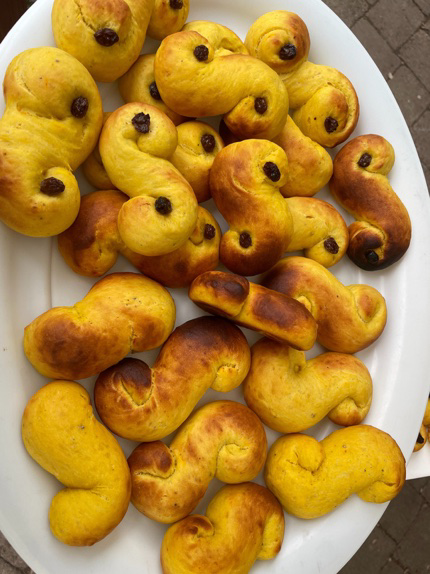
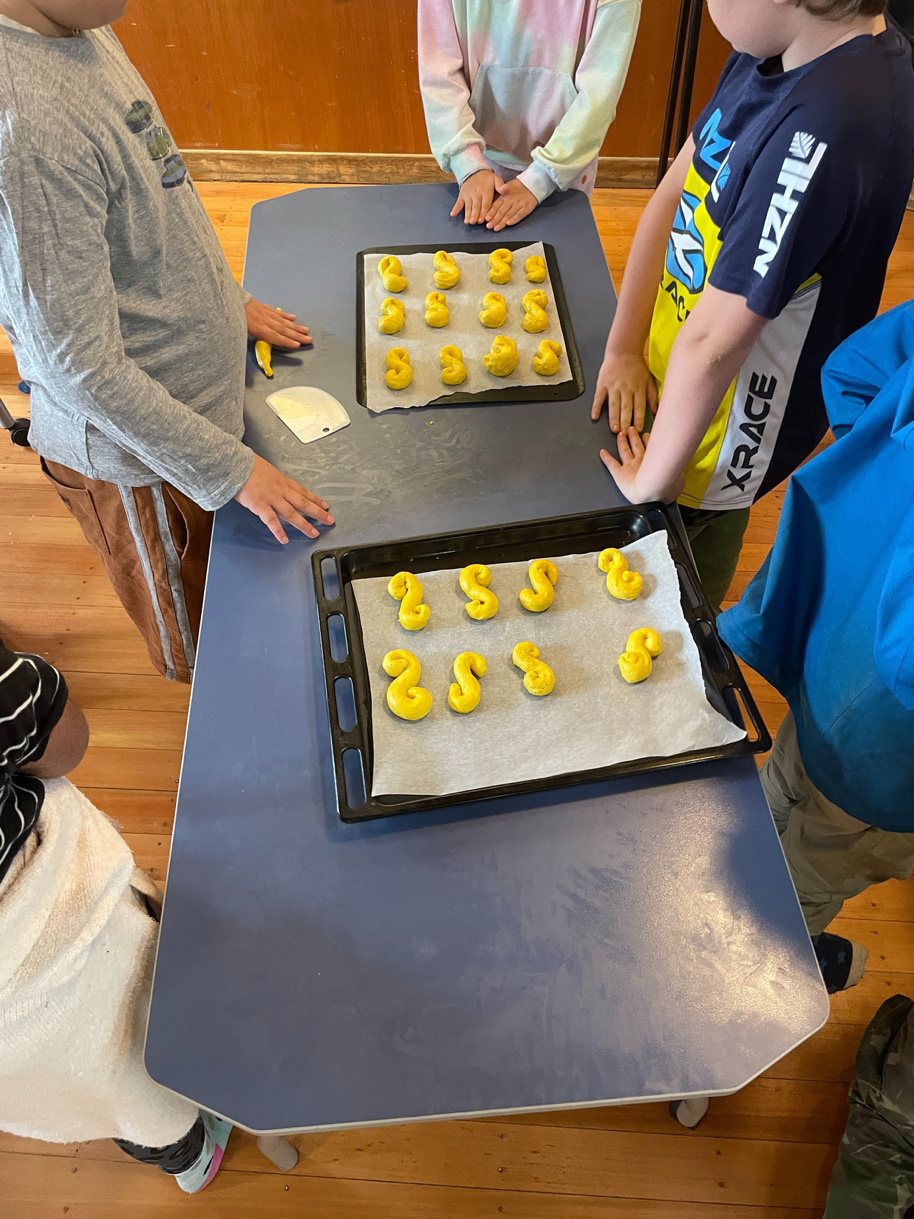
St Lucia Buns are traditionally baked in Sweden to celebrate St Lucia’s Day on December 13, which marks the beginning of the Christmas season in the Nordic countries. The buns symbolise the bringing of light into the darkness of winter, as St Lucia was known for her kindness and light-bringing spirit. The golden colour of the buns (traditionally achieved with saffron) is associated with the light of the season and the promise of warmth and hope during Advent and Christmas. Makes about 12 large buns.
Ingredients
2 cups (480 ml) whole milk
1/2 cup (115 g) unsalted butter
1/4 cup (60 ml) honey
1 packet (2 1/4 tsp) active dry yeast
4 1/2 cups (540 g) all-purpose flour
1/2 tsp salt
1/2 tsp ground cardamom (optional, but adds a lovely warmth)
1/2 tsp saffron threads (optional; if adding, steep in a tablespoon of warm milk for 5 to 10 minutes before adding with the rest of the milk in step one)
Zest of 1 orange (optional, for a citrus twist)
1 egg (for egg wash)
Sugar for sprinkling (optional)
Method
Warm the milk. In a saucepan, heat the milk and butter together over medium heat until the butter melts and the milk is warm (about 110 F / 43 C). Stir in the honey and remove from heat. Let it cool slightly, until it is warm but not hot.
Activate the yeast. Sprinkle the yeast into the warm milk mixture. Stir gently to combine, and let it sit for about 5 to 10 minutes until the yeast becomes foamy.
Make the dough. In a large mixing bowl, combine the flour, salt, and cardamom (if using). Add the yeast mixture and stir until the dough starts to come together. Add the orange zest (if using) and continue kneading the dough until smooth and elastic, about 5 to 8 minutes. You can do this by hand or use a stand mixer with a dough hook.
Let it rise. Transfer the dough to a lightly oiled bowl, cover with a clean towel, and let it rise in a warm place for about 1 hour, or until it has doubled in size.
Shape the rolls. Punch down the dough and divide it into 12 equal pieces. Roll each piece into a long rope, then shape each rope into a swirl or a simple S shape (traditionally these are shaped like the letter S to symbolise light, but feel free to get creative). Place the shaped rolls on a baking sheet lined with parchment paper.
Second rise. Cover the rolls with a clean towel and let them rise again for about 30 minutes, until puffed up.
Preheat the oven. Preheat your oven to 375 F (190 C).
Egg wash. Beat the egg and brush it over the tops of the rolls for a golden finish. If desired, sprinkle a little sugar on top for a touch of sweetness. Press a raisin into each of the two curls of the S for the traditional look.
Bake. Bake for 12 to 15 minutes, or until the buns are golden brown and cooked through. Let them cool slightly on a wire rack.
Serve. These buns are best served warm, either as they are or with a little butter. Enjoy the lovely sweetness and the warmth they bring.
Recipe: Christmas Wreath (Kranzkuchen)
A soft, lightly sweet braided bread, shaped into a ring and studded with almonds and candied peel. Makes one large wreath.
Ingredients
500 g strong white flour, 7 g instant yeast, 80 g sugar, 1 tsp salt
1 tsp ground cardamom, zest of one orange
250 ml warm milk, 80 g soft butter
2 eggs (one for the dough, one for glazing)
100 g raisins soaked in warm water or rum
50 g chopped candied orange peel, 50 g flaked almonds
Pearl sugar for the top
Method
Warm the milk and stir in the sugar and yeast. Let it stand for ten minutes until foamy. In a large bowl combine flour, salt, cardamom, and orange zest. Pour in the milk mixture, the soft butter, and one beaten egg. Mix to a soft dough and knead for ten minutes until smooth and elastic. Cover and let it rise in a warm place for an hour, until doubled.
Knock the dough back. Drain the raisins and knead them in with the candied peel. Divide the dough into three equal pieces and roll each into a long rope about 50 cm long. Plait the three ropes together, then bring the ends round and pinch them to form a wreath. Lift onto a lined baking tray. Cover and let rise for another forty minutes.
Brush with the second egg, beaten. Scatter with flaked almonds and pearl sugar. Bake at 180 C for 30 to 35 minutes, until deep golden and hollow-sounding when tapped underneath. Cool on a rack. Best eaten the day it is baked, with butter, but excellent toasted on Christmas morning.
Spiced Apple Cider
Warm a generous jug of apple cider or apple juice in a saucepan with a cinnamon stick, a few cloves, a sliced orange, and a thin slice of fresh ginger. Heat gently for 15 minutes without letting it boil, then strain into mugs. Serve hot on cold evenings, or chilled over ice on a warm summer Christmas.
Vanilla Crescents (Vanillekipferl)
A short, almondy biscuit, dusted in vanilla sugar. Makes about 40.
Cream 200 g soft butter with 80 g icing sugar and the seeds of one vanilla pod. Stir in 100 g ground almonds, then 250 g plain flour. Bring together and chill for an hour. Pinch off small pieces, roll into little fingers, and curve into crescents on a lined tray. Bake at 170 C for 12 minutes, just until pale gold. While still warm, roll gently in vanilla sugar (caster sugar mixed with the scrapings of a second vanilla pod). Store in a tin.
Crafts
Beeswax Candles for the Tree
Tree candles are small, slender candles, about 12 cm tall, that clip to the branches in metal holders. Rolled candles are easiest with children. Take a sheet of natural beeswax, cut to about 12 by 8 cm. Lay a length of cotton wick along the short edge, fold the wax over it, press, and roll firmly to the end. Warm the wax briefly in your hands if it cracks.
Safety notes for tree candles. This is the heart of a Waldorf Christmas, and it asks for real care. Use only a fresh, well-watered tree, never one that has been standing dry for weeks. Clip candles upright on branch ends, never under another branch. Light them only when an adult is in the room, and never leave the room while they burn. Keep a bucket of water and a damp cloth within reach. Burn for fifteen to twenty minutes at a time, then snuff. Trim wicks before each lighting. If a child or pet is uneasy with open flame, fairy lights are a fine substitute and the festival is no less holy for it.
Straw Stars
Soak natural rye or wheat straws in warm water for an hour until pliable. Take six straws of equal length and lay three over three to form a six-pointed star, with the centres crossed. Tie the centre tightly with strong cotton thread, looping in a figure of eight, and pull snug. Trim the ends to neat points, or split each end and curl back for a feathery star. Hang on red thread.
The Nativity Scene
The nativity figures of Friedrich Ostheimer, hand-carved and softly painted in Germany since the 1940s, are the gold standard in Waldorf homes and are often added to one by one across many Christmases. For a homemade figure, a simple felt Mary takes an evening: a cone of blue wool felt, a small wool head wrapped over a ball of stuffing, a fold of cream felt for the veil. Joseph is the same in brown. The child is a tiny wool baby in a walnut-shell crib.
Songs and Verses
Silent Night, verse one (Joseph Mohr / Franz Gruber, 1818, public domain).
Silent night, holy night,
All is calm, all is bright.
Round yon Virgin Mother and Child,
Holy infant so tender and mild,
Sleep in heavenly peace,
Sleep in heavenly peace.
O Christmas Tree, verse one (traditional German, public domain).
O Christmas tree, O Christmas tree,
How lovely are thy branches.
Not only green when summer’s here,
But also when ’tis cold and drear.
O Christmas tree, O Christmas tree,
How lovely are thy branches.
Quiet, Quiet (Advent song). Sung softly at the close of each Advent evening, growing quieter as Christmas draws near.
Quiet, quiet, the stars are shining,
Quiet, quiet, the night draws near,
Quiet, quiet, a star is rising,
Quiet, quiet, the Christ is here.
A Steiner Christmas verse.
Behold the sun
At the midnight hour.
Build with stones
In the lifeless ground.
Thus in decline
And in the night of death
Find creation’s
New beginning,
Strengthening morning.
Singing the carols is not optional in a Waldorf Christmas. It is how the festival enters the body. Sing them often, sing them slowly, sing them even when no one feels in tune.
Story Suggestion: The Little Fir Tree
Hans Christian Andersen’s classic fairytale tells of a small fir tree who longs for purpose, only to discover that the quiet present moment of being rooted and green is itself the purpose. It is a tender, slightly melancholy story, perfect for reading aloud by candlelight in the days before Christmas. Children of all ages are held by it. A beautiful companion to the more joyful tellings of the nativity.
A Story for Children: The Night the Animals Could Speak
There is an old story that on Christmas Eve, at the stroke of midnight, the animals can speak. In a small barn behind a small house, an old grey donkey stood chewing hay. Beside him stood a black and white cow, and in the rafters slept three brown hens. Outside, snow was falling.
When the church bell rang twelve, the donkey lifted his head. "Tonight," he said, in a voice like soft bells, "is the night."
"What night?" said the cow, surprised to find she could speak.
"The night a child was born in a stable like ours," said the donkey. "An ox and a donkey kept him warm with their breath. The straw was his bed."
The hens fluffed their feathers. "In a stable like ours?"
"In a stable like ours," said the donkey.
The cow looked at the manger in the corner, full of sweet hay. The hens looked down at the donkey’s wise grey ears. And all four of them stood very still and very quiet, and breathed warm breath into the cold barn, just in case any small thing should need it tonight.
Outside, the snow kept falling, and a single star shone over the roof.
Materials List
Pantry
Whole milk, butter, honey, active dry yeast, flour, salt, cardamom, saffron, orange, egg, sugar for Lucia buns
Strong white flour, yeast, butter, milk, eggs, raisins, candied orange peel, flaked almonds, pearl sugar, cardamom for Christmas wreath
Apple cider, cinnamon, cloves, ginger, orange for spiced cider
Butter, icing sugar, ground almonds, plain flour, vanilla for crescents
Nature table
A length of green silk or wool felt, moss, pine and fir sprigs
A small cave or stable (wooden or made from bark)
Stones and crystals, a single gold star
The nativity figures (Mary, Joseph, the child, the ox, the donkey, the shepherds, sheep; the three kings to arrive on Jan 6)
Beeswax for candles, a bowl for the Christmas star
Crafts
Sheets of natural beeswax, cotton wick, metal candle clips for tree candles
Rye or wheat straws, strong cotton thread, red hanging thread for straw stars
Wool felt in blue, brown, cream, wool stuffing, walnut shells, fine sewing thread for homemade nativity figures
For the day
A real Christmas tree (cut fresh, well-watered), a sturdy stand
A bucket of water and damp cloth kept near the tree, a small bell
Lanterns and beeswax candles, the carol book
The best tablecloth, candles for the table, greens for the doorways
Gifts wrapped in plain paper and red ribbon
Adapting for Different Ages
For the youngest (ages 3 to 6)
The whole festival is the magic. Keep words few and gestures slow. Let them help knead the St Lucia dough, hang one straw star, lay the Christ child in the manger, blow out the candles. Sing the carols in the simplest voice. Do not explain. The lit tree at dusk is the teaching.
Grades 1 to 3
This is the age of the acted-out nativity. Set up a small play space, give them a blue cloth for Mary and a brown one for Joseph, and let them tell and re-tell the story for days. The twelve Holy Nights begin on Christmas Eve and run to Three Kings on Jan 6; mark each one with a candle, a song, a small ritual. Children of this age love the counting. The Little Fir Tree read aloud by candlelight is perfect for this age.
Grades 4 to 8
Older children can carry the meaning more consciously. Introduce the idea of the Holy Nights as a quiet reflective time, one for each month of the coming year. A simple journal can be kept: a dream, a thought, a wish for each night. Invite gentle conversation about why your family celebrates: the cosmic image of light born in dark, the story of the child, the kindness of the innkeeper, what it might mean to make room.
A Note for the Parent
There is enormous pressure to make Christmas perfect. The catalogue tree, the photographed table, the pile of gifts that proves your love. None of this is the festival. The festival is a candle on a green branch, a child laid in straw, a song sung by a tired family in a quiet room.
If the bread burns, if the carol breaks down, if only one craft got made, the night will still come, and the light will still be born. Keep it small. Keep it true. The children will remember the hush, the candle, your face by the tree. Nothing else.
About This Guide
This guide was written in collaboration with Sophie, co-founder of Starpath Learning and a Waldorf teacher, homeschool mentor, and curriculum developer. The St Lucia buns recipe, spiced apple cider, Quiet Quiet Advent song, The Little Fir Tree story suggestion, and the weekly Advent-table progression all come from her original Waldorf Festival materials.
Further Reading
Cooper, Fynes-Clinton and Rowling, The Children’s Year (Hawthorn Press)
Carey and Large, Festivals, Family and Food (Hawthorn Press)
Druitt, Fynes-Clinton and Rowling, All Year Round (Hawthorn Press)
Hans Christian Andersen, The Little Fir Tree