

Easter, and the wider Spring Festival, is the great outbreath of the year. After the long inward turn of winter, the sap rises, the earth wakes, and new life pushes up through the dark soil. This guide brings together everything you need to celebrate at home: the story (both the resurrection and a full Waldorf-style Spring story), Holy Week, crafts, recipes, songs, and age-appropriate ways to make the season come alive with your children.
The Meaning of the Festival
The Spring Festival is a celebration of renewal, rebirth, and the return of light after the darkness of winter. It marks the beginning of outward movement, growth in nature, fresh energy, and a shift toward longer days. This festival is deeply connected to the natural world, encouraging a sense of wonder and reverence for the season’s changes.
When the festival coincides with Easter, it carries additional themes of transformation, letting go, and embracing new beginnings. The symbolism of eggs, hares, and blossoming flowers reminds us of nature’s renewal. In a Waldorf-inspired approach, the festival is a time for the celebration of light and growth through storytelling, song, crafts, and shared activities that bring people together in harmony with the season.
Of all the festivals on the Waldorf wheel, Easter is the most cosmic. It is not set by a calendar date but by sun, moon, and earth together: the first Sunday after the first full moon after the spring equinox. Easter is the festival that lifts us out of merely earthly time and reminds us that the human being lives within a great breathing of stars and seasons.
For families who do not hold the Christian story, the same image holds: from the dark, life rises. This is true for all of us.
For the Southern Hemisphere
Easter is a cosmic festival, set by the equinox, the moon, and the sun together. Its date is the same across the world: the first Sunday after the first full moon after the March equinox. For the Southern Hemisphere, that date falls in autumn, not spring, and this changes the festival’s mood in one important way.
The wider Spring Festival described below, with its blossoms, its eggs, its willow crowns, and the King Winter and Lady Spring story, belongs for Southern Hemisphere families to September and October, when your earth is actually waking. Many Southern Hemisphere families keep a full spring festival then, and when Easter itself comes in March or April, they celebrate it as its own quieter festival, leaning on the resurrection image, the new green blade rising through soil, and themes of transformation and letting go, rather than on the full spring pageantry.
Both readings are true. In the Southern Hemisphere autumn, the seeds that are falling now will rise in spring. The resurrection image does not require a blossoming outer world; it only requires trust that life continues under the earth. Keep the Easter story, the dyed eggs, and the candle. Save the flower crowns and the King Winter tale for September.
The Easter Story
When the Sabbath was past, while the sky was still grey with the last of night, Mary Magdalene came to the garden where they had laid him. She came with spices in her hands and grief in her heart. The disciples had scattered. Peter had wept. The women walked together because no one wished to walk alone.
But the stone was rolled away. The tomb was open. And inside, only the linen cloths, folded and still.
Mary stood in the garden and wept. A man came near, and she thought he was the gardener. "Sir, if you have carried him away, tell me where." He spoke one word. He spoke her name. "Mary." And she knew him.
And under the same sky, in every field and wood, the seed that had been buried in the dark earth all winter was pushing up its first green blade. Life was rising. The earth herself was answering.
A Spring Story: King Winter and Lady Spring
A full original story by Sophie, suitable for children of all ages.
Long ago, when the world was young, the seasons walked among the earth as rulers of their time. Through the dark months, King Winter reigned in his frozen hall, wrapping the land in frost and hush. His cloak of ice stretched over field and forest, and his breath stilled the rivers until they lay as smooth and silent as polished glass. No flower dared bloom, no bird dared sing, and all creatures waited in quiet slumber.
But the earth does not sleep forever.
One day, as King Winter sat upon his throne of blue ice, deep in the heart of his cavernous kingdom, a sound broke the stillness, a steady, quiet drip… drip… drip…. A single drop of water, falling from the roof of the cavern. Then another. And another.
The Winter King’s icy fingers curled around the arms of his throne. He narrowed his frost-bright eyes. "Who dares disturb my kingdom?" he called, his voice echoing through the cavern.
The question drifted on the wind, heard by the children of the earth, those who listened to the land and knew its secrets. They had waited all through the long, dark months, whispering to the frozen soil, feeling the first stirrings of warmth hidden deep below. They knew it was time.
Four children, one for each of the elements, set out on a journey to gather the gifts of awakening, the only things strong enough to break Winter’s hold and call forth the Spring.
The first child, whose heart belonged to the earth, journeyed to the mountains, where the gnomes worked in secret halls. The tunnels glowed with the light of hidden gems, and the air hummed with the steady tap-tap-tap of hammers on stone.
"The world is waking," the child said, "but King Winter does not hear it. We need a gift to show him."
The gnome elder, wise and slow-moving as the stones themselves, nodded. "Take this," he said, pressing something cool and smooth into the child’s hands. A single crystal, clear as morning frost, but if you looked closely, you could see the light of something new forming within.
The second child, as swift and bright as a river in spring, ran to the waters where the nymphs drifted in silver-blue veils. The streams still lay frozen, but beneath the ice, the currents trembled.
"The world is stirring," the child called. "But King Winter does not feel it. We need a gift to show him."
The nymphs swayed in the shallows, voices like rippling water. From beneath the ice, they lifted a single white lily, as pure as the last snowfall. "This is a promise," they whispered. "The rivers will run free again."
The third child, light-footed as the wind, climbed high into the trees where the sylphs danced between the bare branches. The air shimmered with their laughter, though the sky still carried the chill of winter.
"The world is singing," the child said. "But King Winter does not hear it. We need a gift to show him."
A sylph, barely visible except for the golden glint of sunlight in her hair, plucked a single feather from the air. "Take this," she murmured, "soft as a breath, strong as the storm. Spring’s winds will rise."
The fourth child, steady and warm, journeyed to the heart of the earth, where embers still glowed beneath the frost. There, the salamanders of the fire stretched and stirred, though their flames lay hidden.
"The world is waiting," the child said. "But King Winter does not see it. We need a gift to show him."
A salamander, golden-eyed and flickering at the edges, cupped its hands. In its palms, a single ember glowed, small but steady. "Take this," it whispered. "Even the smallest warmth can melt the frost."
And so, the four children, each carrying their gift, journeyed together through silent forests and frozen fields, across rivers still locked in ice, and at last, they reached the great cavern of King Winter.
The gates of ice loomed before them, sharp as spears, but they did not hesitate. They stepped forward as one.
The Winter King’s voice rumbled like distant thunder. "Who dares disturb my kingdom?"
The children stood tall.
"We come with the gifts of the earth," the first child said, holding up the crystal. It caught the dim light of the cavern and sent it shimmering through the ice.
"We come with the promise of the rivers," the second child said, offering the white lily. Its petals, though delicate, seemed to glow.
"We bring the breath of the skies," said the third, lifting the feather. A sudden wind stirred through the cavern, making the icicles tremble.
"And we bring the fire that never dies," said the fourth, revealing the ember, pulsing like the heart of the earth.
King Winter’s pale eyes narrowed, and for a long moment, all was still.
Then, from the farthest edge of the cavern, a new sound rose, light as a breeze, warm as the first golden light of dawn. A song, sweet and clear.
Lady Spring had come.
She stepped forward, her gown woven from petals, her hair threaded with ivy and blossoms. The earth beneath her feet softened, and the air shimmered with the scent of fresh rain and wildflowers.
"King Winter," she said with a smile, "you have ruled well. You have hushed the land, let it sleep, and given it rest. But your time has come to slumber, too. The earth stirs, and life calls to awaken."
The Winter King frowned. "The earth is safe in my keeping. What need has it for change?"
Lady Spring bent down, pressing her palm to the frost-covered ground. From beneath her fingers, a small green shoot pushed upward, tiny, but strong. A single bud swelled, then burst into bloom, a crocus, purple as twilight and bright as the morning sun.
The Winter King stared. A crack ran through his frozen throne.
He turned to the children, who still held their gifts. Each gift was a whisper of the world waking.
The Winter King let out a long, slow sigh. He knew his time had ended.
"Very well, Lady Spring," he said at last. "I will take my rest. But do not forget, when the time is right, I will return."
Lady Spring curtsied, her eyes warm and knowing. "I would not dream of forgetting."
And with that, King Winter rose from his throne. He pulled his cloak of mist and ice around him and stepped into the deepest shadows of the cavern. As he vanished, the last frost melted from the stones, and a warm breeze rushed through the hall.
The children cheered. Lady Spring laughed, and with a single step, she led them back into the golden light.
The rivers ran free. The trees stretched their branches. The birds lifted their voices in song. And so, the world bloomed once more.
The Week Before (Holy Week)
Palm Sunday, the green branch. Bring in pussy willows or the first budding branches. Let the children carry one through the house. Speak of welcome, of joy that goes before sorrow.
Holy Thursday, the washing of feet, the meal. A quiet supper together. Wash one another’s hands at the table with warm water and a soft cloth. Light a single candle. Speak little.
Good Friday, the quiet, the tomb. A still day. No music, or only quiet music. Take down bright colours from the nature table and lay a dark cloth. Place a single closed seed or a stone. The children may sense the hush. Let them.
Holy Saturday, the waiting, preparing the moss garden. Today the hands are busy. Build the moss garden together. Dye the eggs. Bake the bread. The waiting is full of small work.
Easter Sunday morning, the rising. Wake before light if you can. Open the windows. Lift the dark cloth. Bring out the green and the gold.
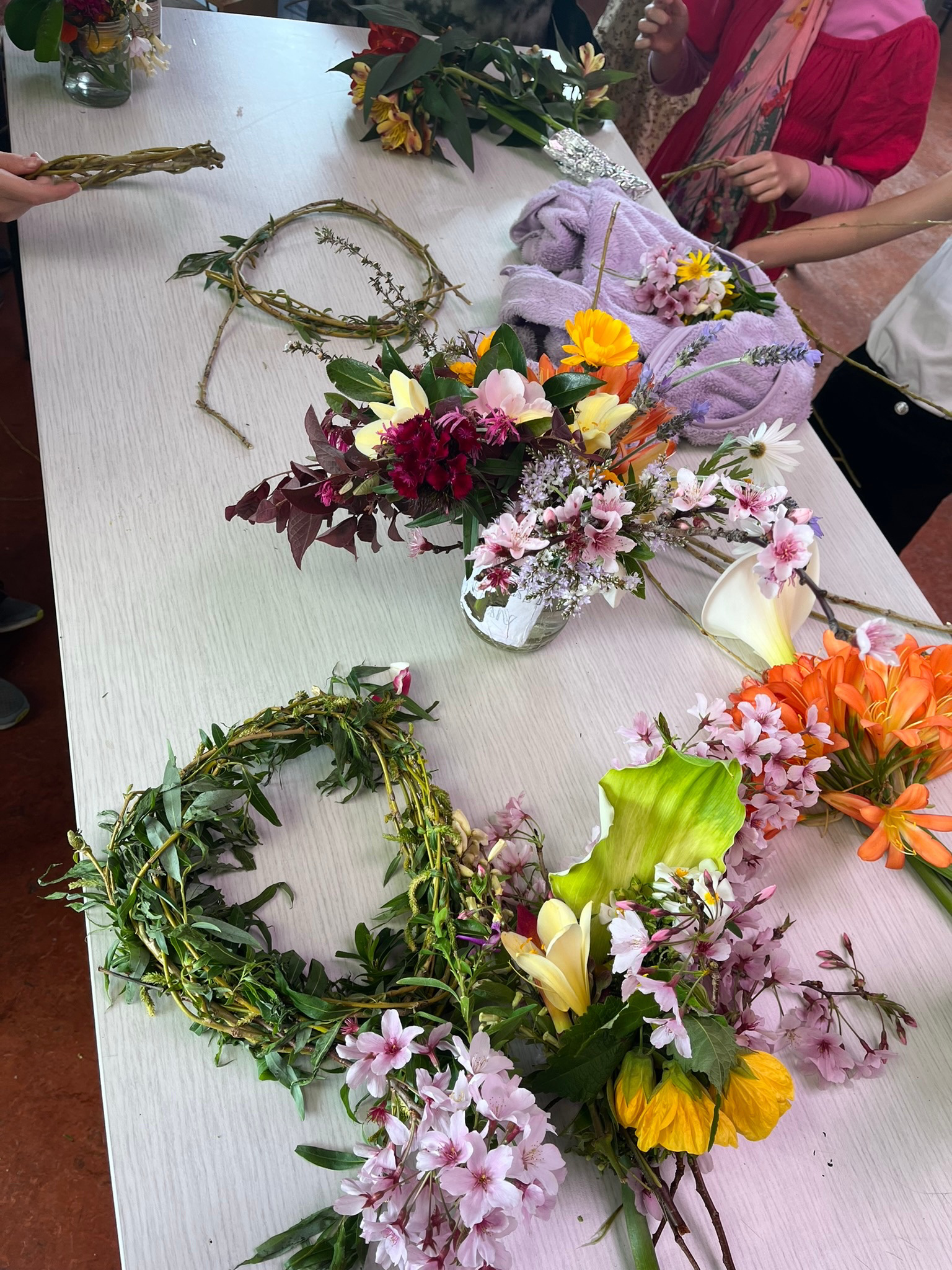
If you are celebrating a standalone Spring Festival rather than Easter, the week before is gentler. Set up a seasonal table in soft spring colours (light green, pink, yellow). Gradually collect natural elements: bird eggshells, feathers, small nests, and fresh flowers. Gather flexible branches (willow works beautifully) for weaving flower crowns, strip the leaves, and soak them. Select and begin learning a seasonal story and song to share.
Festival Day, Morning to Evening
Sunrise walk. Wrap warmly and walk out before the sun is up. Stand together facing east. When the first light comes over the hill or the rooftops, be silent for a moment. Even small children remember a sunrise walk for years.
The opening of the moss garden. Return home to find the moss garden as it was left, but now the stone is rolled away from the small tomb, and inside is empty, with perhaps a folded white cloth or a single white flower. Children gather around. No long words are needed. Let them look.
Easter breakfast. Hot cross buns warm from the oven, the naturally dyed eggs in a bowl, fresh butter, milk, the first wildflowers on the table. Light a beeswax candle. This is a slow breakfast.
Flower crowns and crafts. Gather fresh flowers and greenery, make flower crowns together, paint or model, and let the children dress the nature table. Make dandelion and mint tea from whatever is blooming in the garden.
The egg hunt. Hide painted wooden eggs or the dyed eggs themselves in the garden, in the moss, in the low branches, behind stones. Each child carries a small basket. For young children, hide eggs in plain sight. For older children, leave riddles or trails of petals.
Group game: In and Out the Dusty Bluebells. A simple ring game, perfect for mixed ages. Children form a circle with arms raised as arches; one child weaves in and out of the arches, singing. When the song ends, they choose a new leader. Repeat.
The afternoon meal and sharing. A simple roast or a vegetable centrepiece, the table set with spring flowers. Save back a loaf or a few buns and walk them to a neighbour. Easter is a festival that wants to be carried outward.
Recipes
Shortbread Cookies with Edible Flowers
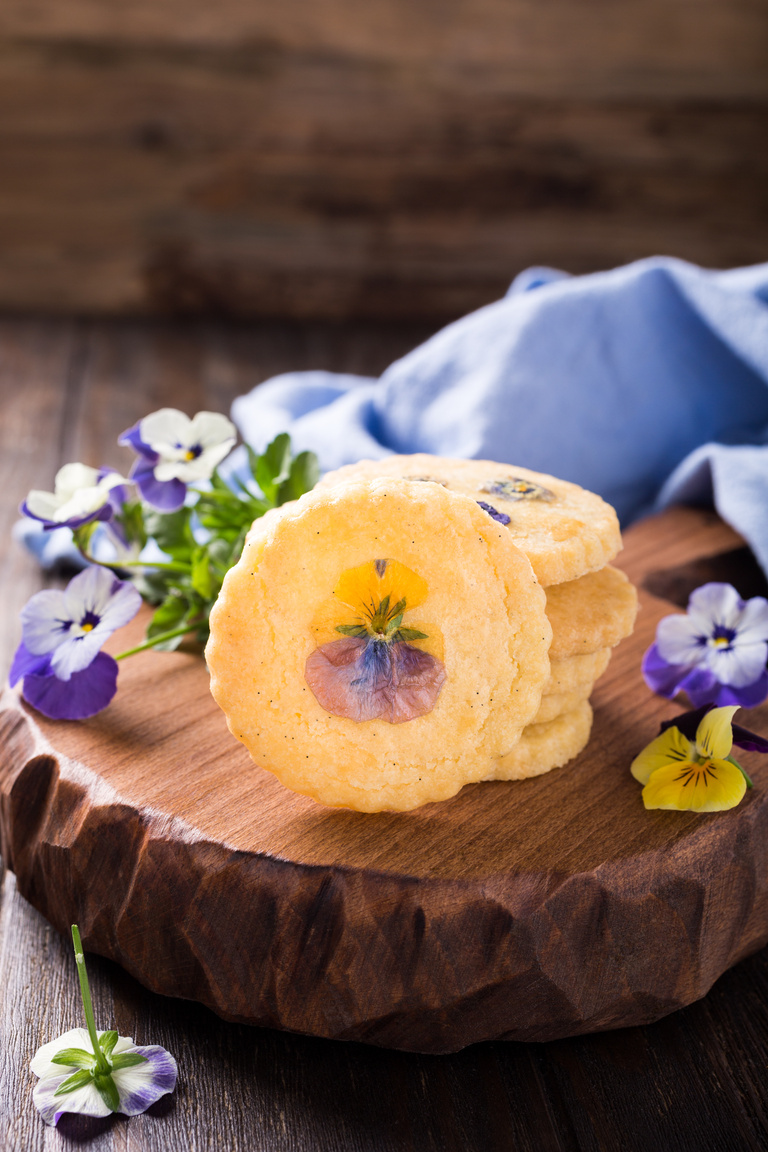
A beautiful spring cookie with pressed flowers baked right into the top.
Ingredients
1 cup (225 g) unsalted butter, softened
½ cup (100 g) sugar
2 cups (250 g) all-purpose flour
½ tsp vanilla extract (optional)
A pinch of salt
Edible flowers (such as pansies, violas, chamomile, or calendula)
1 egg white (optional, for securing flowers)
Method
Prepare the flowers. Gently rinse the edible flowers and pat them dry. Remove any tough stems, leaving just the petals or delicate blooms.
Make the dough. In a large bowl, cream the softened butter and sugar together until light and fluffy. Add the vanilla (if using) and mix well. Sift in the flour and salt, then mix until a soft dough forms. If it feels crumbly, gently knead it with your hands until it holds together.
Chill the dough. Wrap in parchment paper or cling film and refrigerate for at least 30 minutes.
Preheat and roll. Preheat the oven to 160 C (325 F). Lightly flour a surface and roll out the dough to about ½ cm (¼ inch) thickness.
Cut and decorate. Use cookie cutters to cut out shapes. Place on a lined tray. Gently press an edible flower onto each cookie. If needed, brush the back of the flower with a little egg white to help it stick.
Bake. Bake for 12 to 15 minutes, or until the cookies are pale golden at the edges. Cool on the tray for a few minutes before transferring to a wire rack.
Hot Cross Buns
A spiced, lightly sweet bun with a flour-paste cross. Makes about 12.
Ingredients
For the dough: 500 g strong white flour, 7 g instant yeast, 75 g sugar, 1 tsp salt, 2 tsp mixed spice, 1 tsp cinnamon, zest of one orange, 50 g softened butter, 1 egg, 250 ml warm milk, 100 g currants or sultanas, 50 g chopped candied peel (optional).
For the cross: 75 g plain flour, 5 tbsp water.
For the glaze: 2 tbsp apricot jam, warmed.
Method
Warm the milk to blood temperature. In a large bowl, mix flour, yeast, sugar, salt, spices, and zest. Rub in the butter. Add the egg and warm milk. Knead for ten minutes until smooth and elastic. Work in the dried fruit. Cover and leave in a warm place for about an hour, until doubled. Knock back gently, divide into 12 pieces, and shape into rounds. Place on a lined tray, close but not touching. Cover and prove for 45 minutes.
Heat the oven to 220 C. Mix the flour and water for the cross into a smooth, thick paste. Pipe a cross over each bun. Bake for 18 to 20 minutes, until golden and hollow-sounding when tapped. Brush with warm apricot glaze while still hot.
Dandelion and Mint Tea
On a sunny spring morning, go out together and gather a small handful of fresh dandelion flowers (the yellow tops only) and a few sprigs of mint. Rinse gently. Place them in a teapot and cover with just-boiled water. Cover and steep for five minutes. Strain into small cups, sweeten with honey if you like.
Naturally Dyed Eggs
Hard-boil 12 white eggs. Set aside. For each color, prepare a separate pot.
Onion-skin red. Simmer the dry papery skins of 8 to 10 brown onions in 1 litre of water for 30 minutes. Strain.
Red cabbage blue. Simmer half a chopped red cabbage in 1 litre of water for 30 minutes. Strain.
Turmeric yellow. Stir 3 tbsp ground turmeric into 1 litre of simmering water.
Beetroot pink. Simmer one large grated beetroot in 1 litre of water for 30 minutes. Strain.
To each cooled dye bath, add 2 tbsp white vinegar. Submerge the cooled eggs. Leave for at least 2 hours, or overnight in the fridge for deepest colour. Lift out gently with a slotted spoon and dry on a rack. Rub with a little soft butter or oil for a soft sheen.
Crafts
Flower Crowns
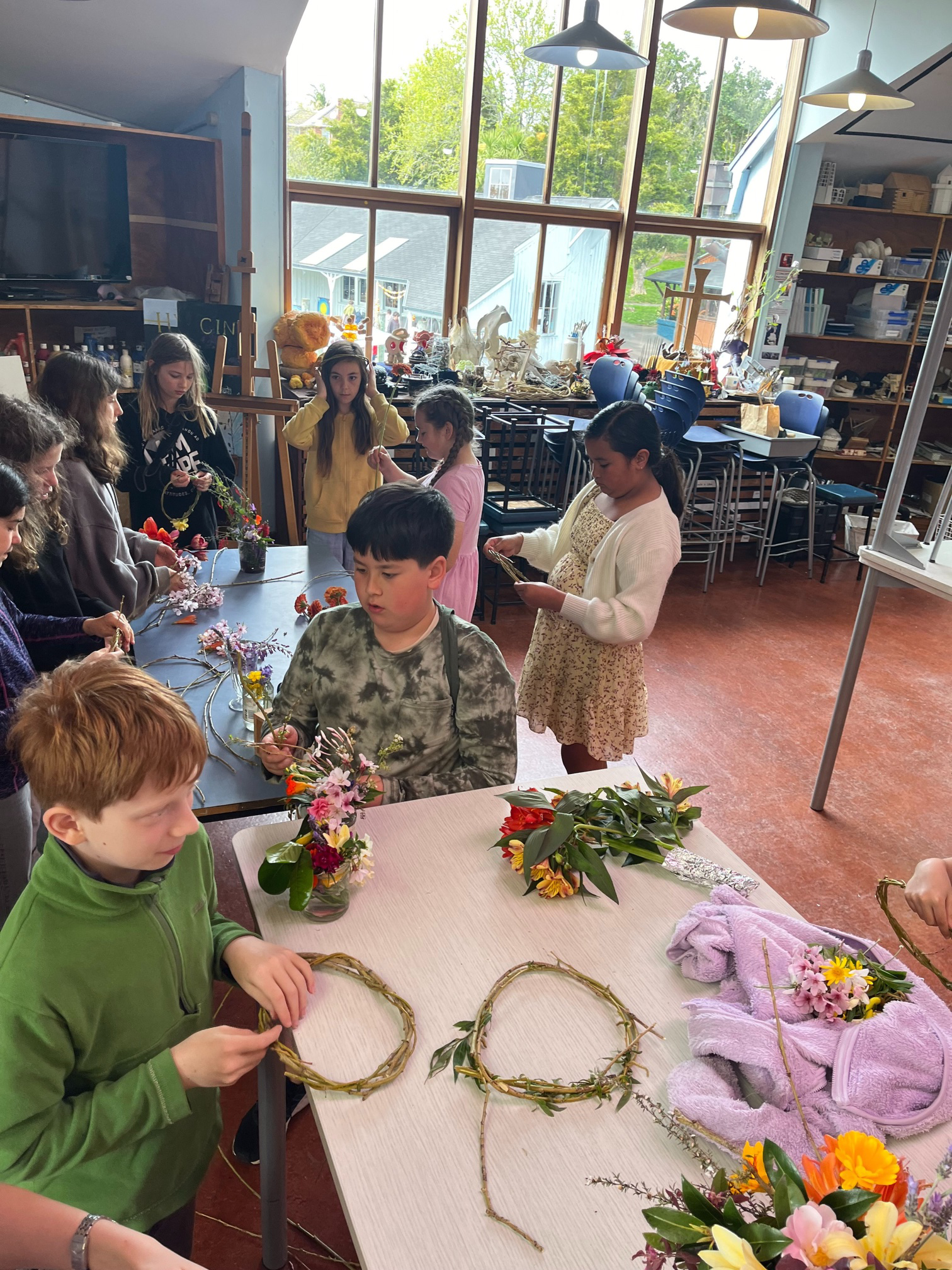
You will need: flexible wood such as willow, wisteria, or young grapevine; a selection of fresh flowers, leaves, and greenery; scissors or garden shears; and a small bucket of water if preparing materials in advance.
Prepare the wood. Find long, flexible branches (about 1 metre in length). Willow is ideal, but any bendable wood works. Strip off the leaves and trim to size. Avoid thick branches, as they will not bend easily. If gathering in advance, soak the branches in water to keep them pliable.
Shape the crown base. Take one length of wood and bend the thinner end into a circle roughly the size of a head. Weave the remaining length in and out of the circle, securing it as you go. If the crown feels too weak, reinforce it by weaving in a second branch.
Decorate with flowers and greenery. Gather an assortment of seasonal flowers, leaves, and soft vines. Tuck them securely into the woven base, layering colours and textures. Adjust as needed to create a balanced and beautiful crown.
Wear and celebrate.
Painted Paper Crayon Egg Relief
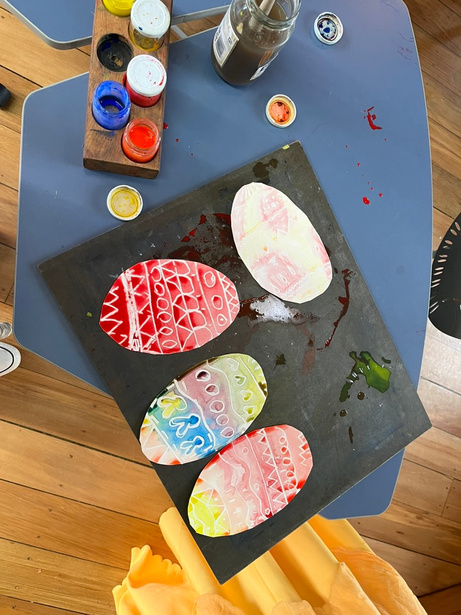
You will need: high-quality card or cartridge paper, scissors, a light coloured pencil, a white beeswax crayon, and watercolour paints.
Prepare the eggs. Trace large egg shapes onto the white card with a light coloured pencil. Carefully cut out each egg.
Draw the patterns. Use a white beeswax stick crayon to draw patterns onto each egg, geometric patterns, dots, or simple pictures.
Paint. Using watery watercolour paint, wash over the eggs. You can use one colour or several blended together. Leave them to dry completely.
This craft works equally well as a standalone Spring activity or as part of Easter preparations.
Beeswax Modelling
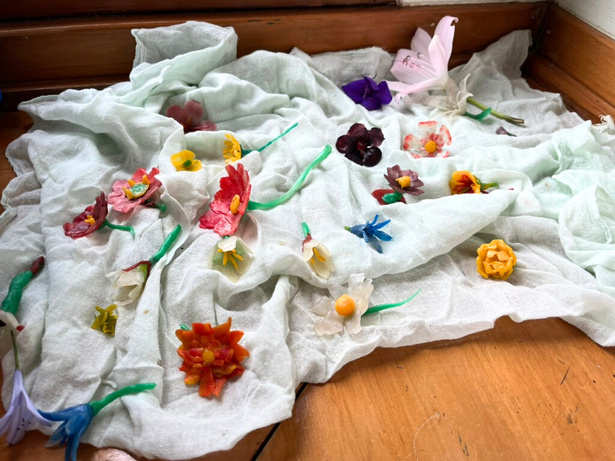
Beeswax modelling can be used with children of all ages, and flowers are one of the most effective things to model. For younger children, encourage them to use their imaginations to model things to make a Spring Garden. For older children, help them choose a blooming flower from the garden, carefully observe it, and then model based on their chosen flower.
You will need: Stockmar modelling beeswax in a range of colours and a light green cloth to display on.
Use the story or flowers blooming nearby as inspiration for modelling beautiful spring-themed flowers, characters, and gardens. Lay out a soft green muslin cloth and display the creations as part of your spring table.
Pastel Spring Bulbs Drawing
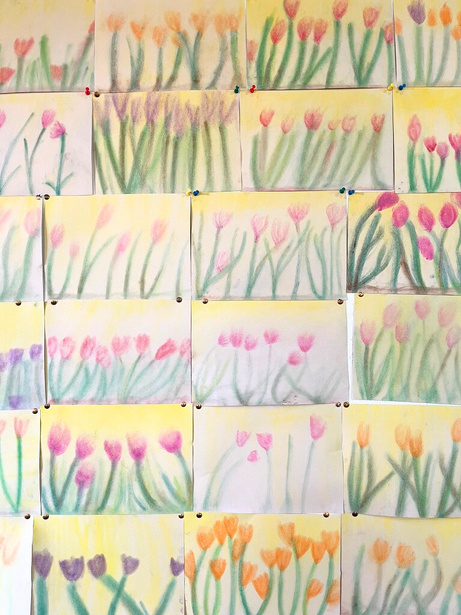
Using chalk pastels and a soft cloth, you can create a similar effect to watercolour painting, and it works particularly well for drawings of plants.
You will need: slightly rough art paper (watercolour paper or sugar paper both work well), a piece of soft cotton fabric (torn flannelette sheet is ideal), and chalk pastels.
Bring yellow softly down from the top, covering the page.
Use green to "grow" the stems and leaves up from the ground.
Select a colour for the blooms and draw them onto the tops of some of the stems.
Deepen stem and leaf colour as needed.
Needle-Felted Flowers
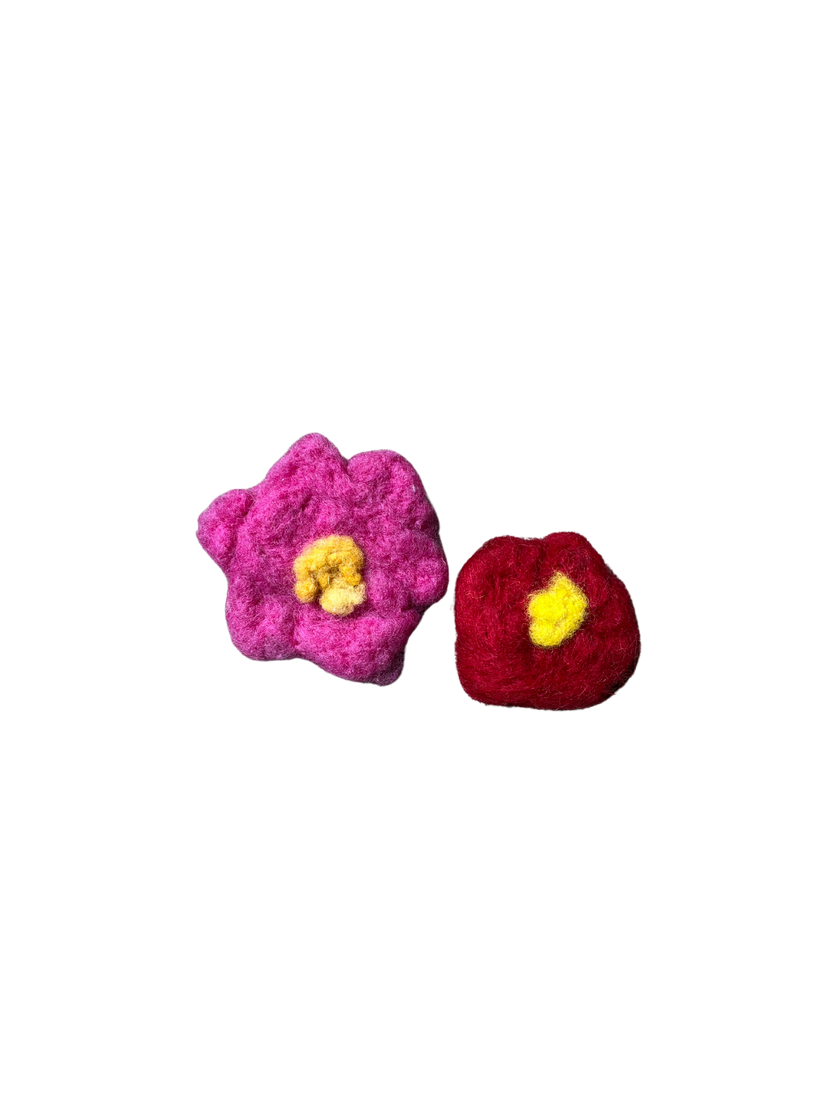
You will need: wool roving in soft spring colours (greens, yellows, pinks, purples, blues), a felting needle, a foam felting mat, flower-shaped cookie cutters (optional), and pipe cleaners (optional, for stems).
Prepare your workspace. Place a foam felting mat on your work surface. If using a cookie cutter, place it on the mat.
Shape the wool. Take small tufts of wool roving and gently spread them inside the cookie cutter, layering lightly to create an even shape.
Start felting. Use the felting needle to carefully poke the wool down into the foam mat, working around the edges first to define the flower shape. Continue felting, turning the flower over occasionally to ensure even firmness.
Add details. Layer additional colours to add depth, yellow or orange for the centre, green for a small leaf. Felt them in gently.
Create a stem (optional). Wrap a pipe cleaner with green wool and felt it lightly to secure. Attach to the back of the flower with additional wool and needle felting.
Finish. Once firm, gently remove from the foam and shape any edges as needed.
For a bigger challenge, this technique can be extended to create a Lady Spring figure, with a wool-wrapped pipe cleaner core, a felted head, and a flowing dress of spring colours.
The Moss Garden (Easter Garden)
A tray, a stone, a path, and the green of new life.
You will need: a shallow wooden tray or a large flat dish, fresh moss (take only a little, from many places), small pebbles, one larger stone with a flat side, a few cut spring flowers (snowdrops, primroses, daffodils), and a small white cloth.
Line the tray with a layer of damp soil. Press the moss down across most of the surface, leaving a clear patch at one end. Set the larger stone at the back of the moss to form the tomb: prop a flat stone against two upright pebbles to make a small cave with an opening. Lay a path of pebbles winding from the front of the tray to the tomb. Tuck small flowers into the moss along the path. Mist lightly with water.
On Holy Saturday, place a small stone closing the tomb. On Easter Sunday morning, before the children wake, roll the stone aside and lay a folded white cloth or a single white flower inside.
Group Activity: Spring Nature Mandala
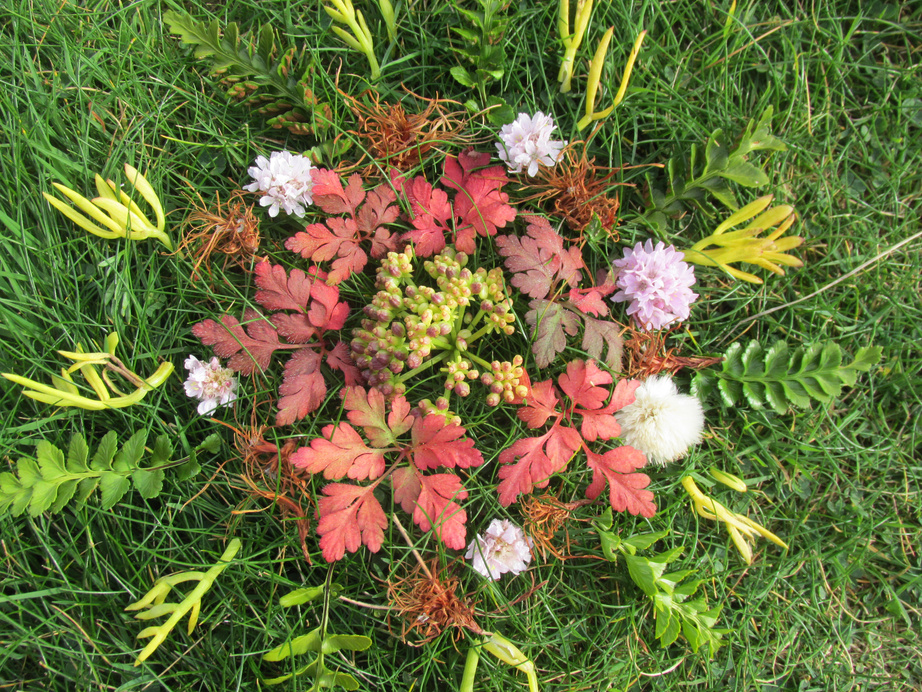
Go on a nature walk together, exploring a garden, park, or forest to collect small natural materials that represent spring: bright petals, fresh green leaves, tiny flowers, smooth stones. Find a flat area to create the mandala: on the ground outdoors, on a wooden table, or even on a large piece of paper or fabric if working indoors.
Start by placing a special object in the middle (a large flower, a unique rock, a cluster of petals). Build outward in circles radiating from the centre, using repeating patterns of leaves, flowers, and stones. Add smaller items like seeds, twigs, or buds to fill in the details.
Stand back together and notice the beauty of the pattern. Since nature mandalas are temporary, take a photo before the wind or time scatters the pieces. If made outdoors, leave it for others to enjoy, or gently return the materials to the earth.
Songs and Verses
Movement verse. Stamping short, short, long.
Winter creeps,
Nature sleeps,
Birds are gone,
Flowers are none,
Fields are bare,
Bleak the air,
Leaves are shed,
All seems dead;
But the spring,
Soon will bring,
Early buds,
To the woods,
Lambs will play,
All the day,
Naught but green,
Will be seen.
All the Birds Sing Up in the Trees. A circle dance: all stand in a circle while a few children are chosen to be little birds flying inside. The circle holds hands and moves to the left, then pauses and raises arms as arches for the birds to fly in and out. The birds return to the centre, and the circle moves to the right.
All the birds sing up in the trees,
now that spring is coming.
Listen, listen, what do they say?
Springtime is the time to be gay!
All the birds sing up in the trees,
Now that spring is coming.
A Steiner Easter verse.
From the dark of the earth
the seed sends forth its shoot.
From the dark of the tomb
the light of the world rises.
In every heart that has waited,
the new life begins.
Now the Green Blade Riseth. J. M. C. Crum, public domain.
Now the green blade riseth from the buried grain,
Wheat that in dark earth many days has lain;
Love lives again, that with the dead has been:
Love is come again like wheat that springeth green.
A simple verse for the seed and the new life, for the youngest.
A little seed, asleep, asleep,
deep in the earth, deep, deep, deep.
The sun calls warm, the rain calls clear,
and up I come, for spring is here.
A Short Story for Children: The Seed Who Thought She Had Died
Once there was a small brown seed who lived in a paper packet on a high shelf. One grey day, a child took the packet down and opened it, and out fell the seed into a hand that was warm.
The hand carried her out into the garden, and a small finger pressed her down into the cold dark earth, and the soil closed over her head.
The seed was very afraid. It is dark here, she thought. I cannot see the sky. I think I have died.
For many days she lay in the dark. The rain came and made her swell. The cold made her shiver. And then, one quiet night, something began to stir inside her. A small white root pushed downward. A small green shoot pushed upward. She did not know what she was doing, but she did it anyway.
One morning she felt the soil break above her head, and warm light poured down, and a voice said, "Look, mother, my seed is up."
And she was a green leaf, lifting toward the sun.
Materials List
Pantry
Butter, sugar, flour, vanilla, salt, edible flowers for shortbread
Strong white flour, yeast, currants, candied peel, mixed spice, cinnamon, oranges, apricot jam for hot cross buns
Fresh dandelion heads and mint, honey for tea
White eggs, onion skins, red cabbage, turmeric, beetroot, white vinegar for naturally dyed eggs
Nature table
Pale green, pink, or yellow cloth
Bird eggshells, feathers, small nests, fresh flowers
A beeswax candle
Seeds, a single closed bulb, the first spring flowers
Crafts
Flexible wood (willow, wisteria, grapevine), fresh flowers and greenery for flower crowns
Cardstock, white beeswax crayon, watercolour paints for painted egg reliefs
Stockmar modelling beeswax and a green cloth for wax modelling
Watercolour or sugar paper, soft cotton cloth, chalk pastels for bulb drawings
Wool roving in spring colours, felting needle, foam mat, flower cookie cutters, pipe cleaners for felted flowers
Shallow tray, fresh moss, pebbles, a flat stone, white cloth for moss garden
For the day
Warm clothes for the sunrise walk
A beeswax candle for the breakfast table
Baskets for the egg hunt
A basket for the neighbour’s loaf
Adapting for Different Ages
For the youngest (ages 3 to 6)
Keep everything sensory and small: the dyeing of eggs, the gathering of moss, the sunrise walk, finding eggs hidden in plain sight. The story is told in a sentence: the stone was rolled away, and life came back. No explanation is needed, the images do the work. Beeswax modelling suits this age beautifully, and a simple flower crown is a treasure to wear all day.
Grades 1 to 3
The resurrection story can now be told in full, simply, without commentary. Sophie’s King Winter and Lady Spring story is wonderful for this age, children will want to hear it again and again, and will often act out the four elemental children on their own afterwards. The moss garden becomes a meaningful image: the stone, the empty tomb, the white cloth. Children will paint and dye eggs with great care and love the wax-resist patterns. Let them knead the dough.
Grades 4 to 8
Older children are ready for the cosmic dimension of Easter. Why does the date move? Look up the moon together. Talk about the equinox. Speak of resurrection as an inner image: what in us has been waiting through a long winter? What is ready to rise? Older children can take responsibility for one part of the day, baking the bread, tending the moss garden, leading the younger ones in flower crown making, or walking the loaf to the neighbour.
A Note for the Parent
Easter often falls in the busy rush of spring, when the garden is calling and the year feels suddenly full. You do not need to do all of this. A single candle at sunrise, one warm bun, one dyed egg in a small hand: this is enough. The festival is not in the doing. It is in the noticing.
Remember that the seed in the dark is doing the real work, quietly, while you sleep. Your own waiting through the long winter has been work too. Whatever rises in your home this Easter, however small, is the new life. Trust it. Let it be.
About This Guide
This guide was written in collaboration with Sophie, co-founder of Starpath Learning and a Waldorf teacher, homeschool mentor, and curriculum developer. The King Winter and Lady Spring story, the flower crowns, painted egg reliefs, beeswax modelling, pastel bulbs drawing, needle-felted flowers, spring nature mandala, and the shortbread with edible flowers recipe all come from her original Seasonal Celebration Toolkit, along with several of the circle verses.
Further Reading
Cooper, Fynes-Clinton and Rowling, The Children’s Year (Hawthorn Press)
Carey and Large, Festivals, Family and Food (Hawthorn Press)
Druitt, Fynes-Clinton and Rowling, All Year Round (Hawthorn Press)