

Martinmas falls on November 11, when the outer light has truly withdrawn and the evenings press in early. It is the festival of the lantern, of the small inner light we each carry into the winter dark. Families gather in the dusk with handmade lanterns, walk slowly, and sing the old lantern songs. This guide brings together everything you need: the story, the rhythm of the week before, recipes, crafts, songs, and age-appropriate ways to celebrate at home.
The Meaning of the Festival
The Winter Festival is a time of reflection, warmth, and inner light during the darkest part of the year. As nature enters its deep sleep and the days grow short, we turn inward, kindling our own inner strength and seeking ways to bring light to the world.
In Waldorf traditions, this festival aligns with midwinter celebrations such as Martinmas (Northern Hemisphere) or the Midwinter Lantern Festival (Southern Hemisphere) and carries themes of hope, generosity, and quiet perseverance through the cold months ahead.
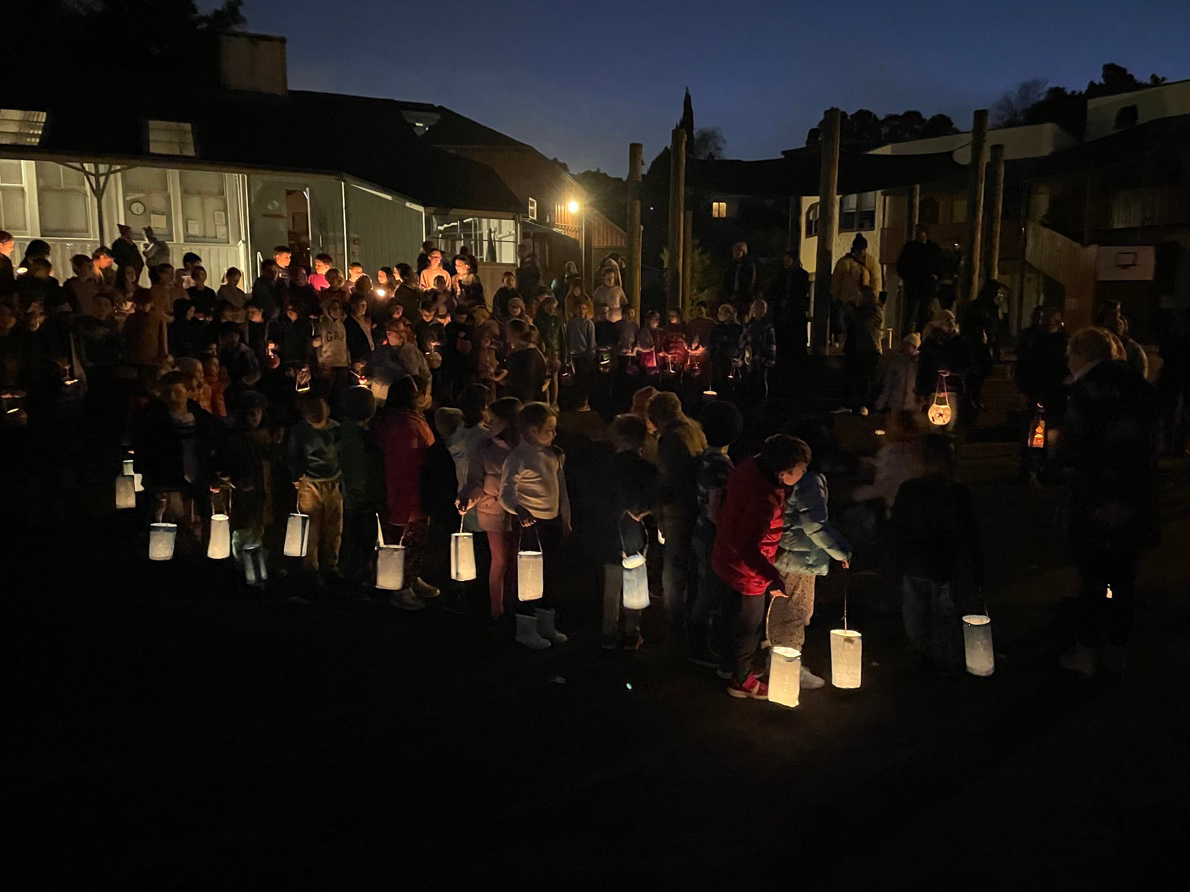
The image of the lantern is central to this time, representing the small yet powerful flame each of us carries within. The Winter Festival encourages acts of finding our inner light, storytelling, singing, and simple handmade crafts that nurture both the heart and the hands. Families and communities often gather for lantern walks, candle-lit storytelling, and seasonal feasts, embracing the beauty of winter’s stillness and the promise of returning light.
Of all the festivals, this can be the easiest time to include wider family or community in celebrations. Crafts, stories, and songs can be done together, and a lantern walk followed by a bonfire can bring a truly magical festival experience to life.
The Story of St Martin
Long ago, when the Roman Empire still stretched across Europe, there lived a young soldier named Martin. He rode a fine horse and wore a thick wool cloak against the winter wind. One bitter night, as Martin came to the gates of the city of Amiens, he saw a beggar shivering by the road. The man wore only rags. His feet were blue with cold, and no one stopped to help him.
Martin reined in his horse. He had no food to give, and no money in his purse. So he drew his sword, took hold of his warm cloak, and cut it cleanly in two. One half he wrapped around the beggar’s thin shoulders. The other half he kept for himself, and rode on into the night.
That very night, Martin had a dream. Christ stood before him wearing the half-cloak, and said gently to the angels, "See, Martin gave me this."
Why It Matters in Waldorf Education
November is the month when the outer light fails. The trees stand bare, the mornings come slowly, and the evenings press in early. In Waldorf traditions, we speak of how, as the world grows dark around us, an inner light begins to wake in the human soul. Martinmas is the festival that names this turning.
The lantern in the child’s hand is no decoration. It is a small, real picture of the soul-light each child carries within. We light it together, we walk with it through the dusk, and we sing so the darkness does not feel lonely. Martin’s act of cutting his cloak is the same gesture in a different form. He shared what kept him warm.
The child learns, without being told, that light grows when it is shared, and that generosity is the first step on the long inner road that leads through Advent toward Christmas.
For the Southern Hemisphere
Martinmas as such is not traditionally celebrated in the Southern Hemisphere. November 11 in the Southern Hemisphere is not a dark, cold turning of the year at all; it is the edge of summer, warm and long-lit. The lantern walk, which is the part of Martinmas most families love, belongs in the Southern Hemisphere to the Midwinter Festival around the June solstice, when dusk falls early and the lanterns truly have a dark to shine into.
Many Southern Hemisphere families take the lantern-making craft, the lantern songs, the bonfire, and the story of Martin sharing his cloak, and keep them all for their winter festival in June or July. Generosity and inner light travel with you across the equator. Only the date moves. See the Winter Solstice guide for a version of this festival suited to the Southern Hemisphere winter.
An Alternate Winter Story: The First Lantern of Winter
A full original story by Sophie, suitable for children of all ages.
As the days grew short and the frost crept over the land, the people of the valley prepared for the long, dark winter ahead. The last leaves had fallen, and the sun, once golden and strong, now cast only a pale glow over the snow-covered fields. In the village at the foot of the mountain, a child named Elias watched as the days grew colder, the nights longer.
"The light is fading," the elders murmured. "Winter is deep, and we must endure its darkness."
But Elias could not bear to see the village so quiet, so dim. The warmth of autumn’s fire had cooled, and no lanterns glowed in the windows. He had heard the old stories, of a hidden flame deep in the mountain, guarded by the ancient ones who knew the secrets of the earth. It was said that this fire had once burned bright in winter’s heart, keeping warmth and light alive until spring’s return.
So, one crisp morning, Elias wrapped himself in his thickest cloak, tucked a lantern into his satchel, and set off toward the towering, snow-capped mountains. He climbed higher and higher, through whispering pines and over frozen streams, until he came to the mouth of a deep cave, hidden behind a curtain of icicles.
Taking a breath, he stepped inside.
The cave was silent except for the steady drip of melting ice. Suddenly, a flickering glow appeared, and from the shadows emerged a circle of gnomes, small, sturdy folk with beards like frost-covered moss and eyes that gleamed like winter stars.
"You have come for the Heart of Winter," one of them said, stroking his long, silver beard.
Elias nodded. "The village is cold, and the nights are long. I want to bring the light back."
The gnomes whispered among themselves, then beckoned him forward. They led him deeper into the cave until they reached a great stone chamber where, in the centre, a flame burned, not like ordinary fire, but golden and steady, casting no smoke, only warmth and light.
"This fire," one gnome explained, "is the First Flame of Winter. It must never go out, or darkness will stretch too long, and cold will take hold of the land."
Elias’s eyes shone. "May I take it to the village?"
The eldest gnome nodded gravely. "But be warned, winter’s breath is fierce. The journey home will not be easy."
Carefully, they placed a small ember from the flame into his lantern. It glowed softly, like a captured star. Elias cradled it close, thanking the gnomes, and turned to make his way home.
As soon as Elias stepped out of the cave, the wind rose up, howling through the mountains like a great unseen beast. Snowflakes swirled around him, thick and heavy, blinding his path. He clutched the lantern tightly, shielding it with his cloak, and pressed forward.
The path down was steep, the stones slick with ice. His feet slid, and more than once, he nearly tumbled. When he reached the frozen river, he hesitated. The bridge was covered in frost, its wooden planks brittle beneath his steps. Halfway across, a gust of wind sent a shudder through the air, and with a crack, a plank splintered beneath his foot.
Elias leapt forward just in time, landing safely on the other side. He turned, heart pounding, and saw that the bridge had broken behind him. There was no turning back now, he had to keep going.
Through the forest he trudged, past bare-branched trees that whispered in the wind. At the edge of the woods, he saw the final stretch, the valley below, where the village lay in quiet slumber. But between him and home was the open field, where the wind was strongest.
He took a deep breath and ran. The wind howled, trying to snuff out the lantern’s glow, but Elias held it steady. Snow whipped against his face, the cold biting at his fingers. Still, he did not stop, not until he reached the village gates.
The people gathered, eyes widening as they saw the warm glow Elias carried. He placed the lantern on the great stone in the center of the village, and as its golden light spilled across the frost, something magical happened. The cold seemed to soften, and the shadows retreated.
"This will be our Winter Lantern," Elias declared. "It will burn until spring’s return, reminding us that warmth and light never truly leave us."
The elders nodded, their faces bright with wonder. They turned to Elias and said, "You have shown great courage and care. From this day forward, it will be your task to journey to the mountain each year and bring back the light of winter."
Elias’s heart swelled with pride. Each year, as winter settled in, he made the journey once more, climbing the mountain, visiting the gnomes, and carrying home the golden flame. And so, the darkness never came to stay, for even in the heart of winter, the light remained.
The Week Before
Pick a date. Aim for Martinmas on November 11, or choose a night close by when winter truly feels like it has arrived.
Set up a seasonal table. Use winter colours (blue, white, purple). Gradually collect natural treasures: winter berries, crystals, cones, small stones.
Begin the lantern. Wash watercolour paper in soft winter colours and let it dry overnight, or gather glass jars and tissue paper for jar lanterns.
Learn a song together. "I Go Outside with My Lantern" is the classic, but any short verse sung at the breakfast table will do. Sing it again at bedtime.
Prepare the food. Gather ingredients for a winter soup and a loaf of bread. If you plan to finish with a bonfire, make sure the wood is dry and the site is safe.
On the day of the festival, light a candle or set a lit lantern on the seasonal table to burn through the afternoon. Lay out craft supplies early.
Festival Day, Morning to Evening
Morning, the final touches. Add the last leaf or star to the lantern. Test the tea light or battery candle. Set the lantern on the windowsill where the child can see it waiting.
Mid-afternoon, baking and quiet play. Bake together and let the house fill with the scent of bread or biscuits. Keep movement gentle, let the child feel the day slowing down.
Late afternoon, the slow gathering. Begin the soup simmering. Lay the table with a candle and a loaf of bread. Dress in warm coats and boots while the sky begins to turn.
Dusk, the lantern walk. Step outside as the first stars appear. Light the lanterns one by one. Walk a quiet, winding route through the garden, the woods, or a familiar path. Sing the lantern songs as you go. Walk slowly, do not hurry.
The shared meal. Return home. Place the lit lanterns in the centre of the table. Ladle soup into bowls. Tear the bread and pass it from hand to hand, as Martin shared his cloak.
An evening verse. Before bed, gather around one lantern still burning and speak together: "The sun has gone to rest, the stars shine in the sky. A little light is in my heart, and there it shall not die."
Recipe: Root Vegetable Soup and Hearth Bread

Make a simple soup from in-season vegetables and serve it alongside rustic flatbread that is simple and ideal for children to help make.
Soup Ingredients
2 large carrots, chopped
1 small pumpkin (or 2 cups cubed), peeled and chopped
2 potatoes, chopped
1 onion, finely diced
2 cloves garlic, minced
4 cups vegetable broth
1 tsp salt, ½ tsp nutmeg, 1 tbsp butter or olive oil
Soup Method
In a large pot, melt butter (or heat oil) over medium heat. Add onion and garlic, cooking until soft.
Add chopped carrots, pumpkin, and potatoes. Stir for a few minutes.
Pour in vegetable broth and add salt and nutmeg.
Bring to a gentle boil, then lower the heat and let it simmer for 20 to 30 minutes, until the vegetables are soft.
Blend until smooth, or mash with a potato masher for a chunkier texture.
Garnish with fresh herbs if you like, and serve warm with hearth bread.
Hearth Bread Ingredients
2 cups flour (whole wheat or white)
1 tsp salt, 1 tsp baking powder
¾ cup warm water
2 tbsp butter or olive oil
Hearth Bread Method
In a bowl, mix flour, salt, and baking powder.
Add warm water and butter or oil. Stir until a dough forms.
Knead the dough for a few minutes until soft.
Divide into small balls and flatten them into circles (like thick pancakes).
Cook in a dry pan over medium heat for 2 to 3 minutes per side, until golden brown.
Quick Martinmas Pretzels (Weckmänner)
Makes 6 small bread men, a traditional Martinmas food in German-speaking Waldorf homes.
Use 500 g of ready bread dough or a simple yeast dough. Divide into 6 pieces. Shape each into a small figure with a round head, a body, and short arms. Press in raisins for eyes and buttons. Brush with beaten egg. Bake at 190 C for 18 to 20 minutes, until golden. Serve warm with the soup.
Crafts
Glass Jar Lanterns with Tissue Paper
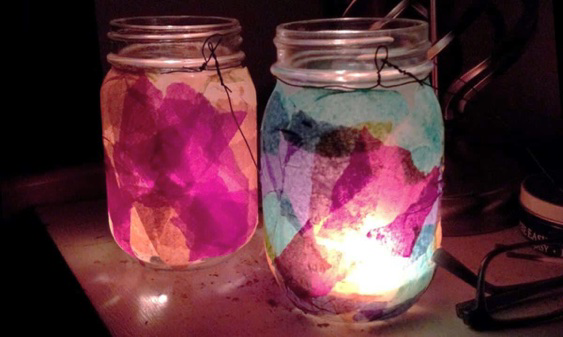
You will need: clean glass jars (one per child), tissue paper in a variety of colours, glue (a mix of PVA glue and water, or Mod Podge), paintbrushes or sponge brushes, wire or twine for handles (optional), and tea light candles (or battery tea lights for younger children).
Prepare the jar. Ensure the jar is clean and dry.
Tear or cut tissue paper. Rip or cut the tissue paper into small pieces. For younger children, soft, organic shapes work best. Older children may enjoy cutting shapes such as hills, trees, and animals (all need to be simple block forms).
Apply glue. Using a paintbrush, spread a thin layer of glue onto the jar.
Attach tissue paper. Gently press tissue paper pieces onto the glued surface, overlapping colours to create a stained-glass effect.
Seal with more glue. Brush another thin layer of glue over the tissue to secure it in place. Set aside until fully dry.
Add a handle (optional). Twist wire around the jar’s rim to create a handle, or tie twine around the neck for hanging. Place the candle in the jar using sticky tack to secure. Light and enjoy.
Folded Paper Lanterns
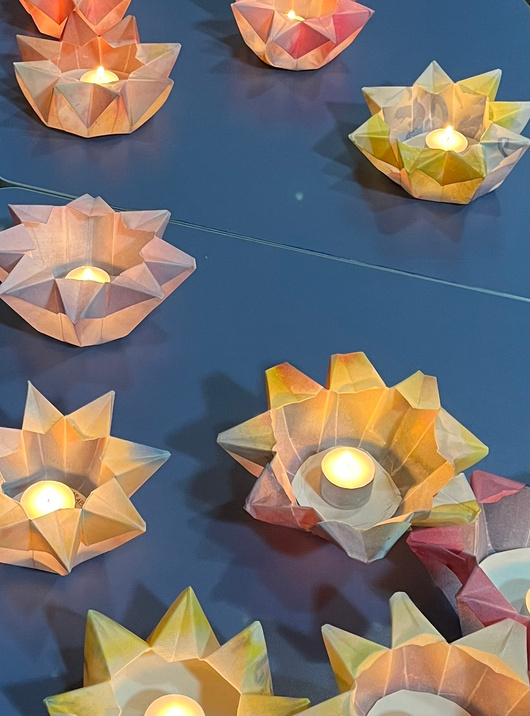
Making lanterns is a central part of any Waldorf winter festival. There are many different versions, but these folded lanterns do not require too many materials and create a beautiful result.
You will need: painted A3 paper (an old wet-on-wet painting works beautifully, or paint warm colours as a painting in advance), a ruler, a graphite pencil, vegetable or baby oil and a brush (to make the paper translucent), and finger-knitted or plaited string for a handle.
The simpler version, better suited to younger children, works with the paper at A3 size and uses a ruler and pencil for accuracy. A slightly more advanced origami-style version suits children aged 10 and up; these lanterns work with the painting cut down to a square, and are best carried in two hands rather than by a handle.
Watercolour Snowy Forest at Night
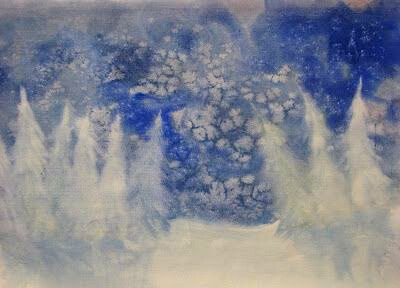
You will need: thick watercolour paper, blue watercolour paint, wide paintbrushes, a sponge or cloth, a jar of clean water, sea salt or coarse table salt, and a waterproof board.
Prepare the paper. Soak the watercolour paper in water for a minute, then lay it flat. Gently dab off any excess water so it is damp but not dripping.
Paint the background. Load your brush with a deep blue watercolour wash and begin painting across the entire page.
Add trees and foreground. Carefully clean your brush and pinch dry. Using the side of the clean brush, paint the foreground and forms of pine trees, lifting paint so they appear white. Wash and dry your brush several times as you go. For younger children, simply leave this step out and enjoy the night sky.
Add salt for snow. While the paint is still wet, lightly sprinkle coarse salt across the surface. The salt will absorb pigment, creating tiny snowflake-like patterns as the paint dries.
Let the magic happen. Set the painting aside to dry completely. Once dry, gently brush off the salt to reveal the delicate snowflake patterns.
Kite Paper Window Stars
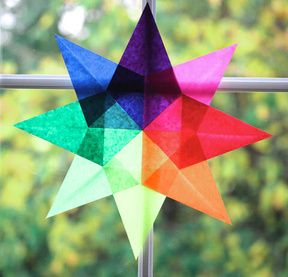
These delicate, colourful stars are a beautiful way to bring warmth and light into the winter season. Made from translucent kite paper, they can be hung on windows to catch the sunlight, creating a glowing, stained-glass effect.
You will need: 8 pieces of coloured kite paper and a glue stick.
Fold the first piece. Fold one square in half to create a rectangle. Unfold. Fold it in half the other way and unfold again. You should now see a + crease across the square.
Create the points. Take one corner and fold it inward to the centre point. Repeat with all four corners so all points meet in the middle, forming a diamond. Fold two neighbouring sides towards the centre line to make a kite shape.
Repeat for all eight pieces. Fold the remaining seven pieces in the same way.
Assemble the star. Place two folded pieces next to each other, with their straight edges aligned. Apply a small amount of glue to the bottom flap of one piece and press the next piece on top. Continue adding pieces, one by one, gluing each in place until all eight form a star shape.
Display. Allow the glue to dry, then use a small loop of tape to attach your star to a sunny window and watch it glow.
Paper Snowflakes

A classic winter craft that brings the beauty of snow indoors. Each snowflake is unique, just like in nature, and this simple yet magical activity is perfect for all ages.
You will need: white paper squares (printer paper, tissue paper, or thin craft paper) and a pair of scissors.
Start with a square piece of paper. If using rectangular paper, fold one corner diagonally to the opposite edge and trim off the excess.
Fold the square in half diagonally, forming a large triangle.
Fold the triangle in half again, creating a smaller triangle. Repeat if you want it even more detailed. You should have a thin wedge shape with two points at the top and a thicker bottom edge.
Trim the top edge of the wedge in a rounded, pointed, or curved shape. This determines the outer shape of your snowflake.
Using scissors, cut small shapes along the edges of the folded wedge. Try triangles, diamonds, half-hearts, or curved cuts. Avoid cutting all the way through the folded centre, or the snowflake may fall apart.
Gently unfold the paper to reveal your snowflake.
Pine Cone Bird Seed Feeder
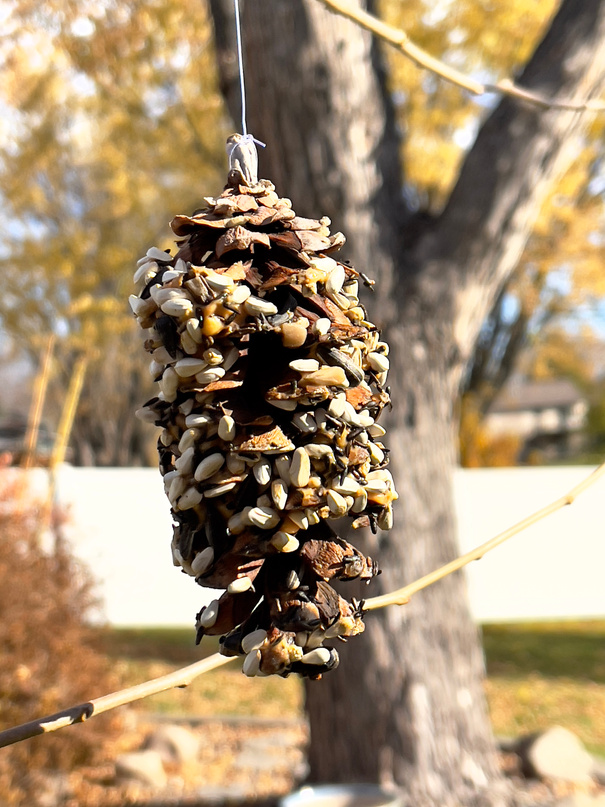
This simple and eco-friendly craft helps birds find food during the colder months while encouraging children to observe and care for wildlife.
You will need: large, open pine cones, peanut butter (or suet for a nut-free option), a birdseed mix, string or twine, a spoon or butter knife, and a shallow tray or plate.
Prepare the pine cone. Choose a large, open pine cone and shake off any loose debris. If the pine cone is tightly closed, leave it in a warm place for a few days to dry and open up.
Attach a string for hanging. Cut a piece of twine about 30 cm long. Tie one end securely around the top of the pine cone, leaving a loop for hanging.
Spread the peanut butter. Using a spoon or butter knife, spread peanut butter (or suet) all over the pine cone, getting into the crevices so the birdseed will stick well.
Roll in birdseed. Pour a generous amount of birdseed into a shallow tray. Roll the pine cone, pressing lightly, until it is fully coated.
Let it set. Place the feeder in the fridge for about 15 minutes to firm up the peanut butter.
Hang your feeder. Find a sturdy tree branch outside and hang the feeder at a height safe from predators. Choose a spot where you can watch the birds enjoy their treat.
Songs and Verses
I Go Outside with My Lantern. English version of the traditional German Ich geh mit meiner Laterne, public domain.
I go outside with my lantern,
my lantern goes with me.
Above, the stars are shining,
below, on earth shine we.
The cock he crows, the cat meows,
la bimmel, la bammel, la boom.
Glimmer, Lantern, Glimmer. Traditional, public domain.
Glimmer, lantern, glimmer,
little stars a-shimmer.
Over meadow, moor, and dale,
flutter, flutter, ghostlike pale.
Glimmer, lantern, glimmer,
little stars a-shimmer.
My Light is Burning Bright. Traditional Waldorf song, public domain.
My light is burning bright,
my light is burning bright,
shining in the dark, dark night,
my light is burning bright.
Working Hard: Stamping Rhythm Poem. Move around the circle, stamping the rhythm of the words, adding simple movements as you go.
We are working, working hard,
We are working, working hard,
Chopping firewood in the yard.
Hold the hammer, hold it tight,
High we lift it; that is right.
Chopping, chopping, chop, chop, chop.
Merrily the pieces drop.
’Tis the funniest game we know,
Makes us warm from head to toe.
The Woodpecker. A simple finger-rhyme: make a fist with one hand while the other pointer pecks at it, then follow the gestures through the verse.
The woodpecker pecked out a little round hole
And made him a house in the telephone pole.
One day when I watched he poked out his head,
And he had on a hood and a collar of red.
When the rain comes down from the dark grey sky,
And the flashes of lightning go zig zagging by,
And the big, big wheels of thunder roll,
He snuggles back into his little round hole.
The North Wind Doth Blow. A circle dance for ages 4 and up. Make an inner and outer circle of children; the outer circle are robins, the inner circle is the barn. On the first two lines, the robins fly left around the barn and stamp on "poor thing". On the second two lines, the barn raises arms to make windows, the robins fly inside and tuck head under arm, then join hands and stamp.
The north wind doth blow, we soon shall have snow,
And what will poor robin do then? Poor thing!
He’ll sit in the barn to keep himself warm,
And hide his head under his wing. Poor thing!
A short evening verse.
The sun has gone to rest,
the stars shine in the sky.
A little light is in my heart,
and there it shall not die.
Group Activity: The Lantern Walk and Bonfire
The lantern walk is the heart of the festival. Invite friends, family, or neighbours to gather in the late afternoon. Walk slowly together through a park, garden, or familiar path as the light fades, each person carrying their own lantern and singing the lantern songs. Keep the pace gentle, let the children feel the rhythm of small feet in the dusk.
At the end of the walk, gather around a small bonfire if you can. Roast marshmallows, share the soup you have prepared, and sing one more verse together before the children head to bed warm and pink-cheeked.
A Story for Children: The Little Lantern Who Was Afraid to Shine
Once there was a small paper lantern, painted in warm reds and golds. On the night of the festival, a child carried her gently down the garden path. But the little lantern was afraid. "I am so small," she whispered to her candle. "My light is only a tiny flicker. The night is so big and so dark. What use am I?"
The candle inside her smiled. "Look up," it said.
The lantern looked up through her painted paper sky. Above her, she saw other lanterns moving through the dusk, each one glowing softly. A red one. A blue one. A small white one shaped like a star. None of them was bright on its own. But together, they made a winding river of light along the dark path.
"Oh," said the little lantern. And she let her candle burn as steadily as she could, and added her small light to all the others.
The child held her close, and sang, and walked on into the night.
Materials List
Pantry
Pumpkin or butternut squash, potatoes, carrots, onion, garlic, vegetable broth, butter, salt, nutmeg
Flour, salt, baking powder for hearth bread
Bread dough or flour, yeast, milk, sugar, egg, raisins for pretzels
A good loaf for the table
Nature table
Winter cloth in blue, white, or purple
Crystals, small stones, winter berries, cones
A beeswax candle, a small lantern figure or a wooden Martin on horseback if you have one
Crafts
Clean glass jars, tissue paper in various colours, PVA glue or Mod Podge, paintbrushes, wire or twine, tea lights
Painted A3 paper, ruler, pencil, vegetable oil and brush, plaited string for folded lanterns
Thick watercolour paper, blue paint, wide brushes, coarse salt for snowy forest
8 pieces of coloured kite paper, a glue stick, for window stars
White paper squares and scissors for snowflakes
Large open pine cones, peanut butter, birdseed, string for bird feeders
For the day
Warm coats, hats, boots, mittens
A thermos of warm cider or cocoa for the walk
Matches if using real candles, battery tea lights for the youngest
Kindling and a safe fire circle if ending with a bonfire
Adapting for Different Ages
For the youngest (ages 3 to 6)
Keep everything simple and sensory. The lantern itself is the heart of the festival. Make it together, hold it together, and sing the same short song again and again in the days leading up. Skip the full St Martin story, or tell only the gesture: "He had a warm cloak, and he shared it." Let the walk be short, let bedtime be early, and trust the candlelight to do most of the work.
Grades 1 to 3
This is the age when the St Martin story, and Sophie’s story of Elias and the First Lantern of Winter, come fully alive. Tell them slowly, by candlelight, perhaps with simple wooden figures or silks draped across a low table. Children at this age love the cloak, the sword, the dream, the long journey through the snow. They will want to hear the story again and again, and will often act it out in play for days afterwards.
Grades 4 to 8
Older children are ready for the deeper meaning of the festival. Around the soup pot, you might wonder aloud together: what does it mean to share what keeps you warm? When have they given something that truly mattered? What is the "inner light" we sing about, and where do we feel it in ourselves? Keep the conversation light and honest, without preaching. Older children can also take charge of real tasks, baking the bread, leading the singing, carrying the lantern at the front of the walk.
A Note for the Parent
Of all the festivals of the Waldorf year, Martinmas is one of the most beloved, and one of the most quietly moving. Something about the small lights moving through the November dusk, the children’s voices singing songs you sang as a child yourself, the warm soup waiting at home, can catch a parent off guard. It is alright to feel it. The festival is doing its work in you too.
You do not need a perfect lantern or a perfect soup. You need only to step outside with your child as the dark comes down, to walk slowly, and to sing. The light you carry together is enough.
About This Guide
This guide was written in collaboration with Sophie, co-founder of Starpath Learning and a Waldorf teacher, homeschool mentor, and curriculum developer. The full Winter story, the glass jar lantern, folded paper lanterns, watercolour snowy forest, kite paper stars, paper snowflakes, and pine cone bird feeder all come from her original Seasonal Celebration Toolkit, along with several of the circle verses.
Further Reading
Cooper, Fynes-Clinton and Rowling, The Children’s Year (Hawthorn Press)
Carey and Large, Festivals, Family and Food (Hawthorn Press)
Druitt, Fynes-Clinton and Rowling, All Year Round (Hawthorn Press)