

Welcome to the Essential Guide for teaching the Science: Home Surroundings (The World Around Me) block.
Whether you are exploring Waldorf education for the first time or actively preparing to homeschool your First Grader, this guide provides a complete blueprint of the philosophy, goals, and daily structure you need to gently introduce geography and environmental science.
The Philosophy: Geography Begins at Home
In a modern, traditional classroom, a six-year-old might be shown a map of the world or asked to memorize the capital of a country they have never seen. In the Waldorf approach, we believe that true geographical understanding does not start with a globe—it starts with the soil beneath the child's feet.
Home Surroundings is the foundation of geography. Before a child can comprehend the vastness of the planet, they must deeply know their own garden, their own street, and their own neighborhood. We guide them to notice where the sun rises, where the moss grows, and how the seasons change the view from their bedroom window.
By shifting the focus from abstract maps to local reality, children achieve several critical developmental milestones:
Spatial Awareness: Developing a grounded sense of 'where I am' in the world.
Sensory Observation: Learning to consciously observe the sounds, smells, and textures of their immediate environment.
Foundational Mapping: Moving from walking the neighborhood to creating the very first, simple drawn maps.
The Curriculum: What You Will Teach
This deeply grounding block is designed to take roughly 16 instructional days. Here is a transparent look at the exact concepts and goals you must cover.
Your Learning Intentions:
Develop the capacity to consciously observe the local environment.
Understand spatial relationships: near/far, above/below, left/right.
Learn the four cardinal directions (North, South, East, West) through the path of the sun.
Create simple maps of a room, a house, and a garden.
Combine observational drawing with declarative sentence writing.
The Waldorf Method: How to Structure a Daily Lesson
To successfully teach Home Surroundings, you must weave together storytelling with physical exploration. Here is exactly how to do it.
Step 1: The Anchoring Story
Provide an imaginative picture of 'home' and 'place' to anchor the day's physical exploration.
Example Story Snippet (The Little Brown Bird):
Once there was a little brown bird who lived in the hedge at the edge of a garden. She had never flown far, but she loved her corner of the world. She knew the flowers that opened early and those that closed before sunset. She knew which patch of grass was softest and where the ants marched in perfect lines.
One morning, her cousin the speckled thrush flew in. “Don't you ever wonder what lies beyond that hedge?” he asked. The little brown bird ruffled her feathers. “I have all I need. Why should I leave? But even the smallest garden is full of wonder. Come — show me.”
Step 2: The Noticing Walk
Take the indoor imagination outside and activate the senses.
Example Exploration Activity:
The Noticing Walk: Take a slow walk outside through your garden, yard, or street. Stop and ask: What can you see? What can you hear (traffic, insects)? What can you feel (bark, stone, leaves)? What can you smell (soil, dampness, dry sun)?
Step 3: Drawing & Writing in the Main Lesson Book
Return indoors to capture the observation in both art and language.
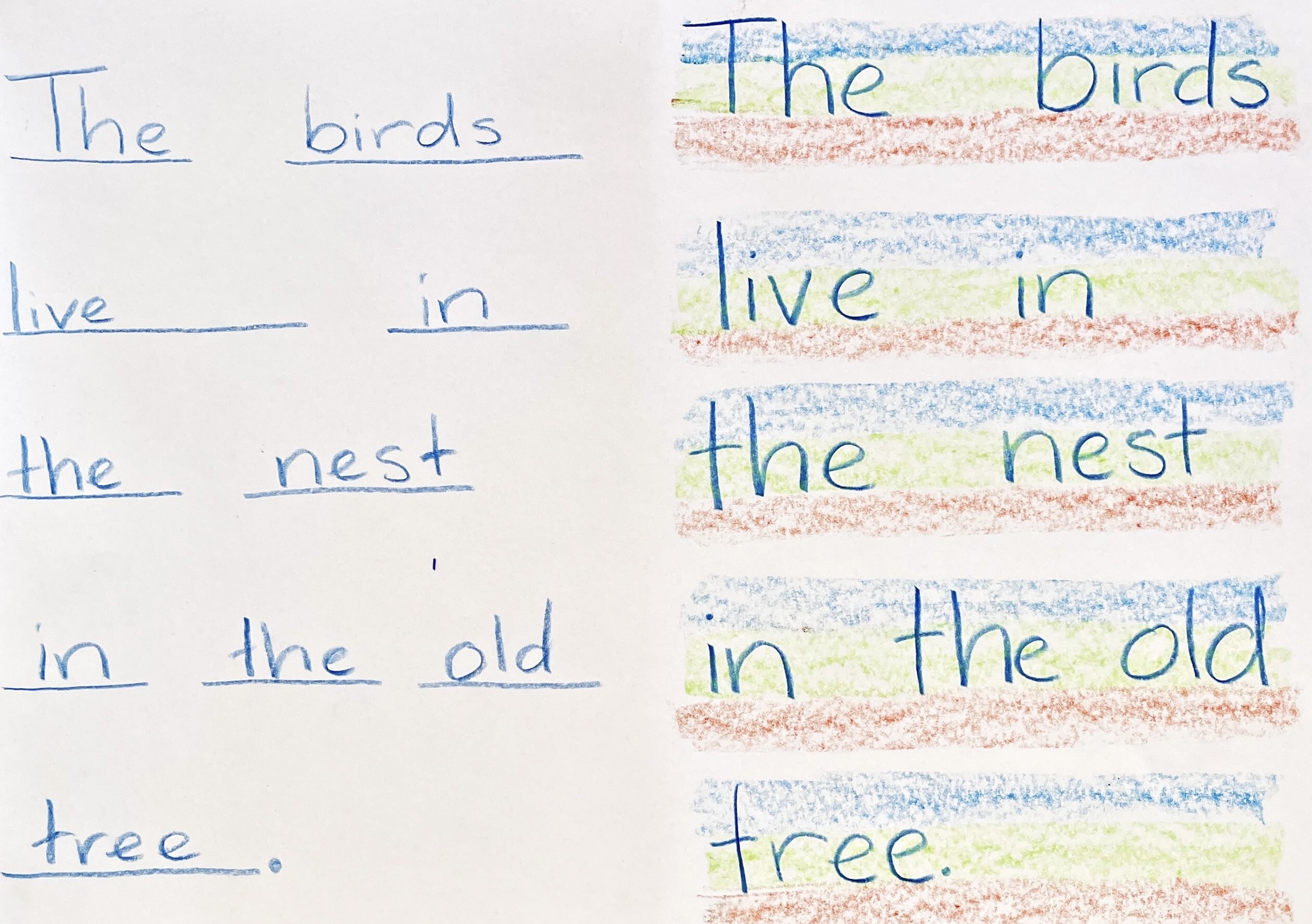
Example Bookwork Instructions:
The Co-Constructed Sentence: Choose one small scene noticed on the walk. Encourage your child to speak a complete sentence, e.g., 'I saw the big tree with a brown bird in it.' Work together to sound out the phonics and write the sentence on the right-hand page.
The Observational Drawing: On the left-hand page, use block crayons to draw the observed scene, focusing on the true colors and shapes of the natural objects you found.
Build It Yourself vs. The Guided Curriculum
You now have the exact blueprint to teach Home Surroundings. If you have the time, you can absolutely use this guide to map out the 16-day progression, write stories that anchor the four directions and local geography, and sequence the first mapping activities.
But for many homeschooling parents, planning three weeks of daily geographical storytelling and perfectly sequenced outdoor excursions is draining.
If you want to focus entirely on exploring the neighborhood with your child rather than lesson planning late at night, the complete Home Surroundings block is ready for you.
What’s inside the complete Block?
When you purchase the full block, all the heavy lifting is done for you. You instantly unlock:
16 Complete, Anchoring Stories: Word-for-word scripts designed to pique curiosity about the local environment before heading outside.
Daily Outdoor Excursions: Specific instructions for noticing walks, tracking the sun to find North/South/East/West, and creating the first maps.
Step-by-Step Main Lesson Book Artwork: Detailed instructions and reference images for illustrating the geography concepts.
Daily Morning Circle: Complete rhyming verses and midline-crossing exercises.
Everything is carefully structured to give you the confidence of an experienced Waldorf teacher, right out of the box.