

Welcome to the Essential Guide for teaching the Math: The Quality of Numbers block.
Whether you are exploring Waldorf education for the first time or actively preparing to homeschool your First Grader, this guide provides a complete blueprint of the philosophy, goals, and daily structure you need to teach early mathematics through imagination and art.
The Philosophy: What is the 'Quality' of a Number?
In a modern, traditional classroom, children are taught numbers purely for counting or calculation. A '3' is simply one more than '2'. In the Waldorf approach, we believe that before a child can calculate with numbers, they must understand the deep, almost magical quality of the number itself.
What does 'One' feel like? It is whole, unified, like the single sun in the sky or the one heart in our chest. What is the quality of 'Two'? It is duality—day and night, left and right, me and you.
By slowing down and dedicating this entire first math block to truly meeting the numbers 1 through 12, children achieve several critical developmental milestones:
A Foundation for Operations: They build a concrete understanding of quantity, setting the stage for addition and subtraction.
Connection to the Natural World: Math is no longer a dry abstract concept on a worksheet; it is alive in nature (the three-leaf clover, the four seasons).
Artistic Confidence: Every single number is met with a beautiful, guided Main Lesson book drawing.
The Curriculum: What You Will Teach
This foundational block is designed to take roughly 14 instructional days. Here is a transparent look at the exact concepts and goals you must cover.
Your Learning Intentions:
Introduce numbers 1 to 12 through fairy tales.
Explore the qualities and quantities of each number in nature and the human body.
Practise writing Roman Numerals and Arabic Numbers.
Count effectively up to 20, backwards from 10, and count by 2s.
Create Main Lesson Book artwork corresponding to numbers.
The Waldorf Method: How to Structure a Daily Lesson
To successfully teach a Waldorf Math block, every single number must follow a specific, three-step rhythm. Here is exactly how you do it, using the Number One as an example.
Step 1: The Imaginative Story
You do not just write a '1' on the board. You tell an engaging fairy tale that isolates the "oneness" of the number. In our curriculum, we use a continuous story of two children (Lina and Arlo) who travel to Number-Land. You will need to prepare 12 continuous stories for this block.
Example Story Snippet (Meeting Raven Numeris):
Lina and Arlo walked into the sunlit clearing. Suddenly, they felt dizzy and had to sit down. When they opened their eyes, nothing was the same. They were standing on the edge of a wide, golden meadow. Before they could speak, a black raven swooped down.
“I am Raven Numeris,” he croaked, “and you have stepped into Number-Land. Only a very special potion with twelve ingredients can open the way back to your home. Here is the first ingredient: the Stone of One. One Sun lights our world; one heart beats in each of you. Feel how one is whole and complete.”
Step 2: Movement & The Quality Exploration
Get the idea into the body and the physical world before taking it to the paper.
Example Movements:
Collect Singles: Indoors or outside, ask your child to find things that appear alone: one spoon on the table, one pine-cone, one special shell.
Movement Burst: Call an action; your child does it once (one jump, one spin, one clap).
Discussion: "What else in the world is there only one of?"
Step 3: Drawing in the Main Lesson Book
Now, you draw the picture together, representing the number.
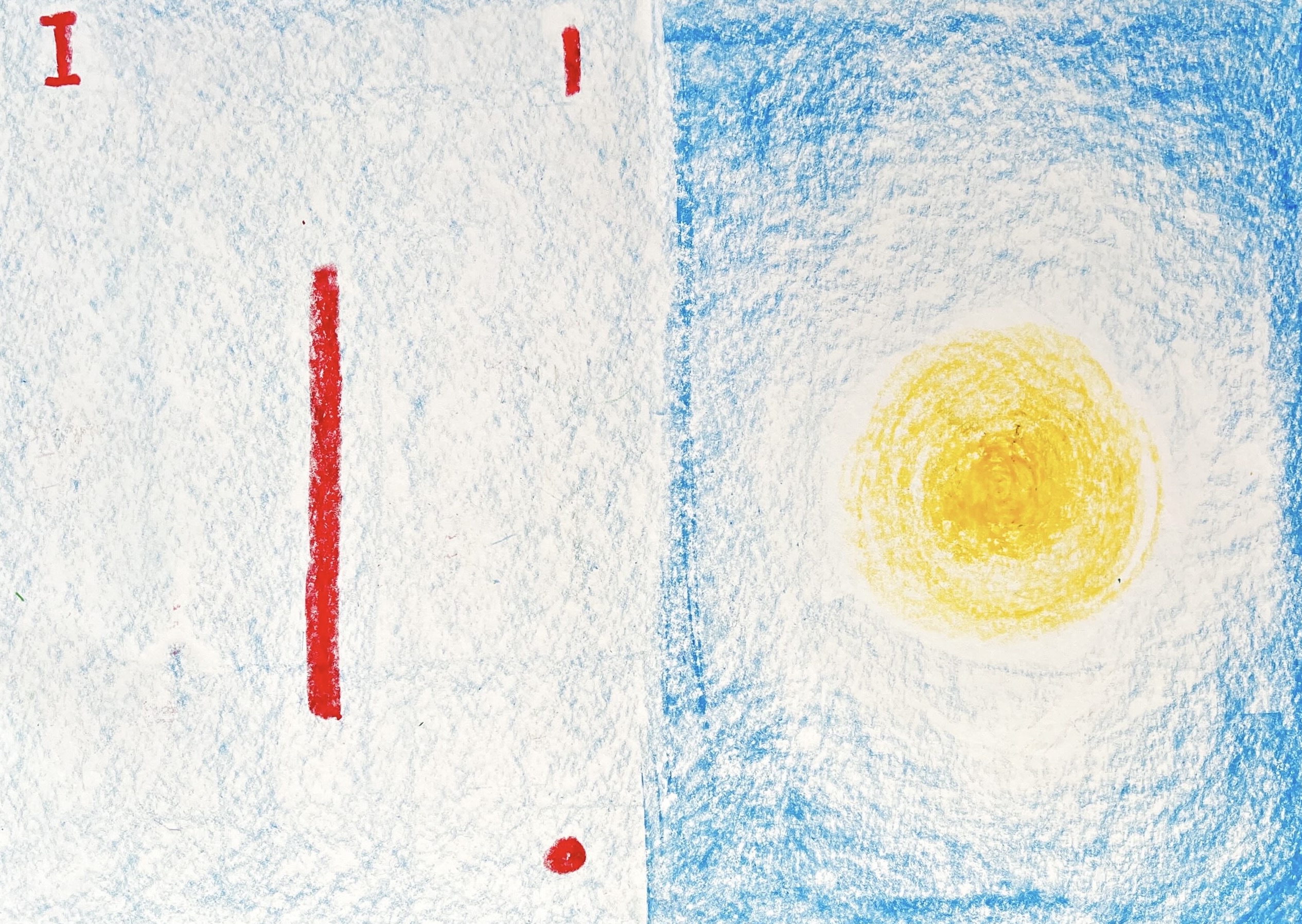
Example Drawing Instructions:
The Picture: With a golden yellow block crayon, draw the 'One Sun' from the story: darker in the centre, fading outward. Bring light blue in from the outside to meet the yellow (do not overlap).
Number Writing: On the opposite page, lightly shade the whole page with any stick-crayon colour. Draw a large number 1 in the centre. In each corner, record other ways of writing 1: a dice pattern (one dot), a Roman numeral (I), and a Tally mark (I).
Build It Yourself vs. The Guided Curriculum
You now have the exact blueprint to teach the Quality of Numbers. If you have the time, you can absolutely use this guide to map out the 14-day progression, write a continuous chapter story travelling through Number-Land 1 to 12, invent movement games, and plan your morning circles.
But for many homeschooling parents, planning 14 days of captivating fairy tales and perfectly sequenced drawings takes immense time, research, and artistic energy.
If you want to focus entirely on connecting with your child rather than planning your evenings away, the complete Math: The Quality of Numbers block is ready for you.
What’s inside the complete Block?
When you purchase the full block, all the heavy lifting is done for you. You instantly unlock:
14 Complete, Enchanting Stories: The complete "Lina and Arlo in Number-Land" saga, word-for-word scripts (no more staring at a blank page).
12+ Main Lesson Book Drawings: With step-by-step instructions and reference images for every single number from 1 to 12.
Step-by-Step Daily Lesson Plans: Telling you exactly what to do, what to say, and what to draw from Day 1 to Day 14.
Daily Morning Circle: Complete rhythmic counting exercises, brain-gym, and songs.
Everything is carefully structured to give you the confidence of an experienced Waldorf teacher, right out of the box.