

Welcome to the Essential Guide for teaching the Math: Number Patterns block.
Whether you are exploring Waldorf education for the first time or actively preparing to homeschool your First Grader, this guide provides a complete blueprint of the philosophy, goals, and daily structure you need to teach skip counting and times tables through rhythmic movement and story.
The Philosophy: Rhythmic Mathematics
In a traditional classroom, children are handed lists of times tables to memorize through rote repetition. In the Waldorf approach, we believe that children are inherently rhythmic beings. Before math enters the head as an abstract concept, it must enter the body as a rhythm.
A times table is simply a rhythmic number pattern. If a child can clap and step a syncopated rhythm, they can naturally learn to skip count by 2s, 3s, 5s, and 10s without friction.
By shifting the focus from rote memorization to rhythmic pattern building, children achieve several critical developmental milestones:
Embodies Mathematics: The physical body learns the mathematics first through stepping, clapping, and tossing beanbags, making the mental recall significantly faster.
Visualizing Patterns: They learn to physically arrange objects (like glass gems) into geometric patterns (pairs, triangles, squares) to "see" the numbers before writing them.
Musicality and Focus: Coordinating speech, movement, and counting requires deep cross-over brain engagement.
The Curriculum: What You Will Teach
This highly active math block is designed to take roughly 16 instructional days. Here is a transparent look at the exact concepts and goals you must cover.
Your Learning Intentions:
Master rhythmic skip counting by 2s, 3s, 4s, 5s, 6s, 10s, and 12s.
Understand the difference between odd and even numbers visually and physically.
Visualise number groupings using counters.
Record number patterns artistically in the Main Lesson Book.
The Waldorf Method: How to Structure a Daily Lesson
To successfully teach Number Patterns, the day must start with vigorous rhythmic movement, followed by a story containing a math problem, which the child then solves with physical objects. Here is exactly how to introduce the concept of 'Pairs' (Counting by 2s).
Step 1: The Rhythmic Morning Circle
Start the day by walking in a circle, counting steps aloud. Start with 10. To introduce odds and evens, you walk and count—say "one" quietly, then "two" loudly with a loud step and a clap. Say "three" quietly, "four" loudly with a clap. Repeat this daily to build the rhythm of the 2s times table into the body.
Step 2: The Math Story & Counter Activity
Tell an engaging story that presents a problem the child must solve along with the characters. We continue the saga of Lina, Arlo, and Raven Numeris.
Example Story Snippet (The Knights and the Horses):
Lina and Arlo approached the castle to help the knights prepare for their quest to find the dragon. The first knight they approached was putting saddlebags onto his horses. He had 12 sacks of goods, so he would be taking 12 horses. He wanted to line them up in pairs for the journey ahead, and had to work out exactly how many pairs he would have...
Activity: Provide 12 glass gems. As you tell the story, have the child arrange the 12 gems into distinct pairs to physically see that 12 equals six pairs of 2.
Step 3: Drawing & Writing in the Main Lesson Book
The conceptual counter work is then recorded beautifully in the Main Lesson Book.
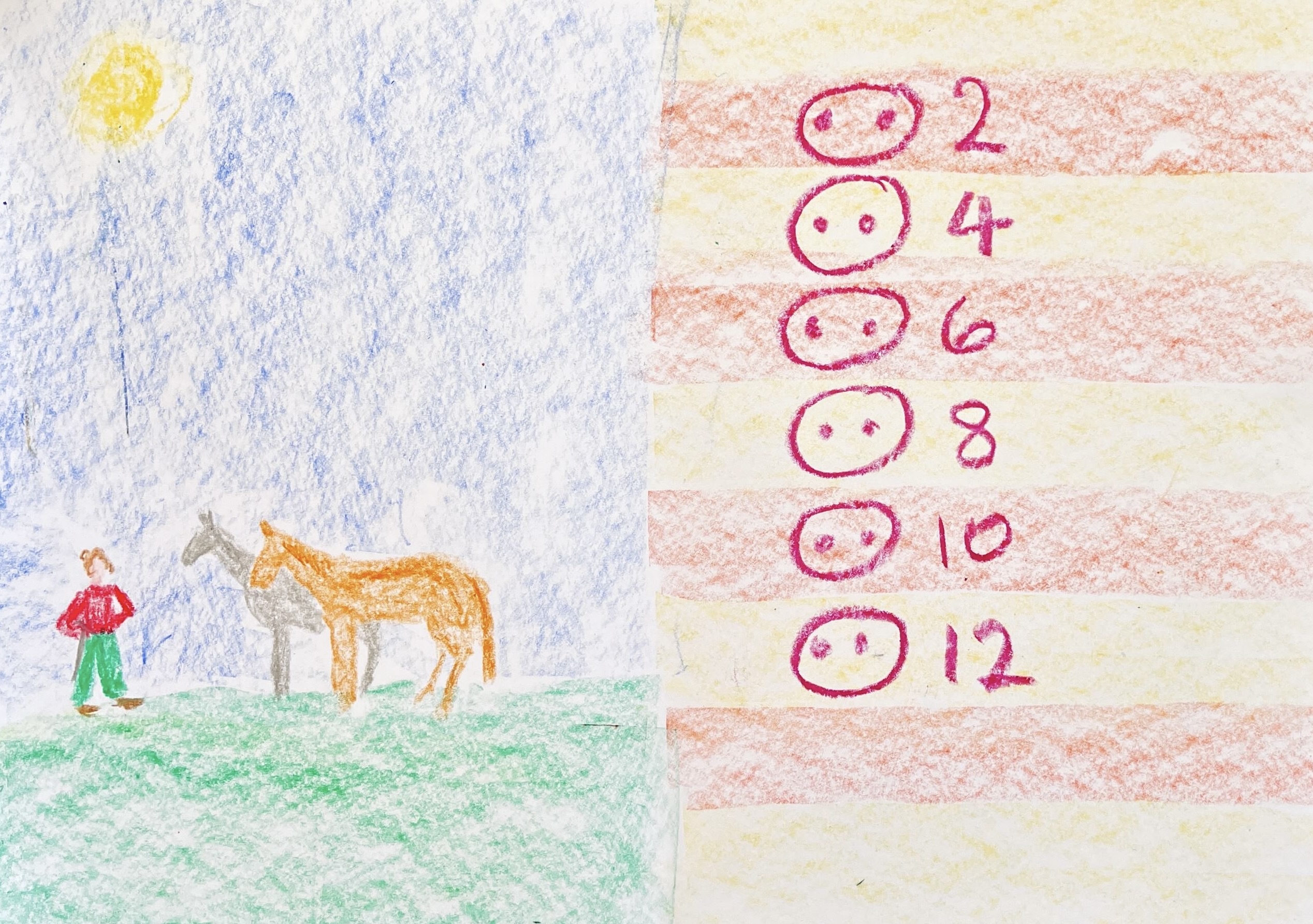
Example Bookwork Instructions:
The Illustration: On the left-hand page, use block crayons to draw the knight and two of his brown horses ready for the journey.
The Number Pattern: On the right-hand page, the child draws the visual representation of the work they did with their counters. They draw two dots, circle them, and write the number '2'. Below that, they draw two more dots, circle them, and write '4'. They continue until they reach 12.
Build It Yourself vs. The Guided Curriculum
You now have the exact blueprint to teach Number Patterns. If you have the time, you can absolutely use this guide to map out the 16-day progression, invent complex rhythmic counting games, and write the daily math story problems allowing the child to discover the 3s, 4s, 5s, 10s, and 12s times tables.
But for many homeschooling parents, planning three weeks of perfectly sequenced mathematical storytelling and inventing corresponding rhythm movements takes immense creative energy.
If you want to focus entirely on playing math games with your child rather than lesson planning late at night, the complete Number Patterns block is ready for you.
What’s inside the complete Block?
When you purchase the full block, all the heavy lifting is done for you. You instantly unlock:
16 Complete, Anchoring Math Stories: Word-for-word scripts following the knights as they encounter problems that can only be solved with the times tables.
Daily Rhythmic Circle Games: Specific instructions for clapping, stomping, and beanbag tossing routines to embody each number pattern.
Step-by-Step Main Lesson Book Artwork: Detailed instructions and reference images for illustrating the geometric number groupings.
Everything is carefully structured to give you the confidence of an experienced Waldorf teacher, right out of the box.