

Welcome to the Essential Guide for teaching the Math: Problem Solving block.
Whether you are exploring Waldorf education for the first time or actively preparing to homeschool your First Grader, this guide provides a complete blueprint of the philosophy, goals, and daily structure you need to teach multi-step addition, subtraction, and multiplication word problems.
The Philosophy: Mathematics as an Adventure
In a traditional classroom, a word problem is usually a dry sentence: "John has 5 apples, he gets 6 more." In the Waldorf approach, we believe that math should be as thrilling as a knight's quest.
We do not teach abstract formulas. We teach about King Maximo, Queen Equal, and their helpful gnomes: Farmer Plus (who always collects more), Tommy Times (who works incredibly fast), Minus (who gives things away), and Divide (who shares everything fairly).
By grounding problem solving in storytelling, children achieve several critical developmental milestones:
Deep Comprehension: They don't just guess which operation to use. They visualize which character is acting in the story (is this a job for Farmer Plus, or Tommy Times?), leading to a profound understanding of the mathematical symbols.
Mental Flexibility: They learn to hold multiple steps in their head, translating an oral story directly into a written number sentence.
Artistic Recording: The math book becomes a beautiful tapestry of colour-coded equations, not a messy workbook.
The Curriculum: What You Will Teach
This capstone math block is designed to take roughly 16 instructional days. Here is a transparent look at the exact concepts and goals you must cover.
Your Learning Intentions:
Consolidate understanding of the four operations (+, -, x, ÷).
Solve multi-step, oral word problems using physical counters.
Translate oral stories into written number sentences (equations).
Develop mental math skills for number bonds strictly to 10 and 20.
The Waldorf Method: How to Structure a Daily Lesson
To successfully teach Problem Solving, you must start in the physical realm with glass gems, and only later move to the written pages of the Main Lesson Book. Here is exactly how to do it.
Step 1: The Rhythmic Morning Circle
Before doing any seated math, you must awaken the child's number sense physically.
Example Activity:
Stepping Over Stones: Move around in a circle while stamping to the beat. Start skip counting while stamping in a chosen pattern (e.g., 2, 4, 6, 8... or 5, 10, 15, 20...).
Step 2: The Math Story & Counter Activity
Tell an engaging story featuring the four operation gnomes. The child must solve the problems the King presents using their physical gems.
Example Story Snippet:
The King asked Lina and Arlo to share what they had learned on their travels. 'First, we met Farmer Plus. He found 12 eggs and Lina found 9 more – Farmer Plus knew how to add them up and tell you how many there are altogether. Then we met Tommy Times. He saw 5 piles of 4 eggs, and knew how many there were altogether very quickly!'
King Maximo was fascinated and paused the children. 'Before you tell me more, please show me exactly how this works with the gems…'
Activity: As you tell the story, have the child arrange their counters on the table to physically solve 12 + 9, and then arrange 5 groups of 4 to solve the multiplication problem.
Step 3: Recording in the Main Lesson Book
The conceptual work is now recorded as formal mathematical sentences.
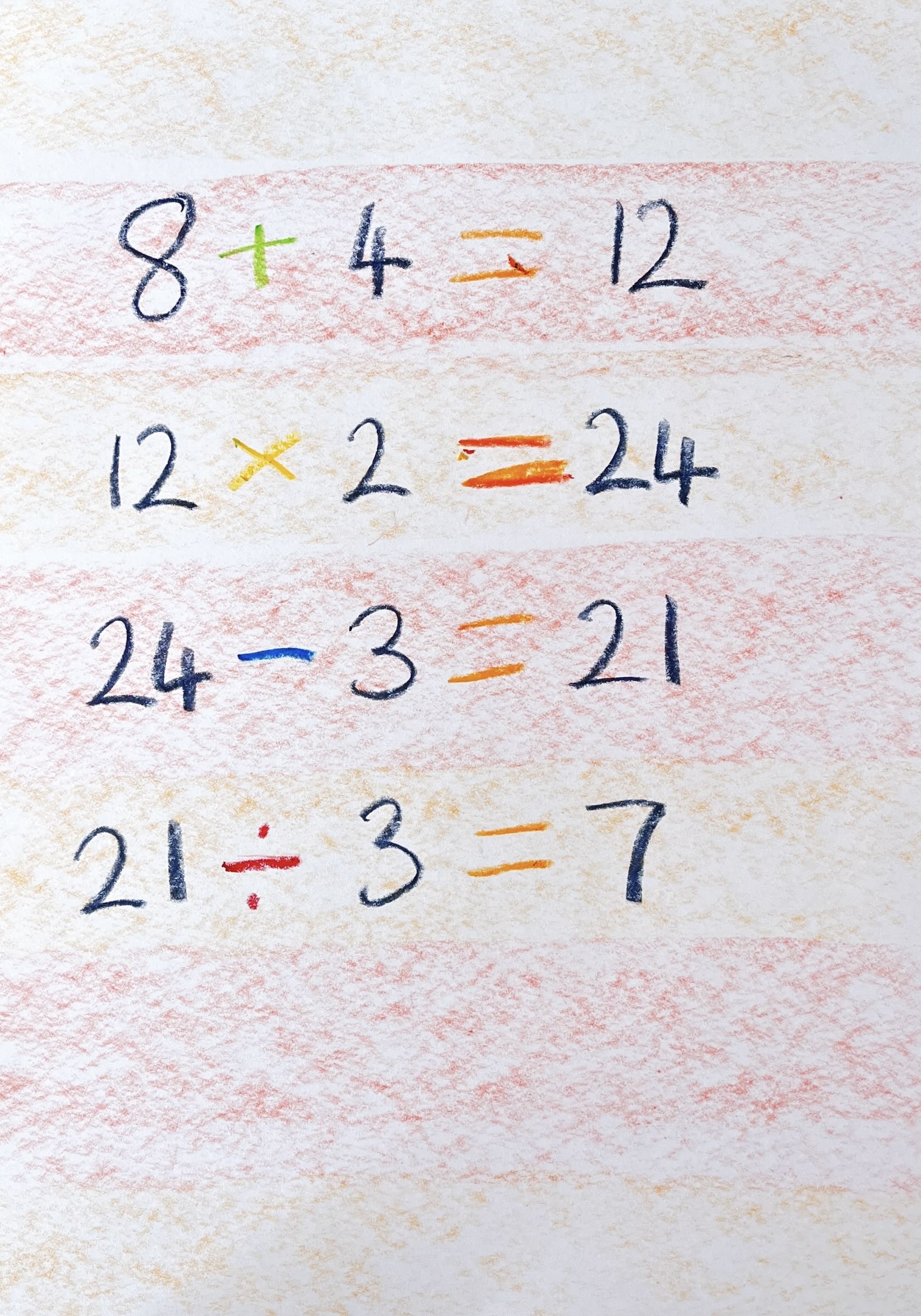
Example Bookwork Instructions:
The Number Sentences: Support your child to use the side of a block crayon to draw stripes across the right-hand page to form writing lines. Next, they use stick crayons (using specific colors: yellow for the times symbol, green for plus) to formally record the problems (e.g., 5 x 4 = 20).
The Illustration: On the left-hand page, use block crayons to draw an imaginative picture of King Maximo and the four math gnomes.
Build It Yourself vs. The Guided Curriculum
You now have the exact blueprint to teach Problem Solving. If you have the time, you can absolutely use this guide to map out the 16-day progression, write the daily math story problems involving all four operations, and sequence the mental math and number bond exercises.
But for many homeschooling parents, planning three weeks of daily, perfectly-paced word problems that challenge the child without frustrating them is a massive undertaking.
If you want to focus entirely on playing and solving math puzzles with your child rather than inventing them late at night, the complete Problem Solving block is ready for you.
What’s inside the complete Block?
When you purchase the full block, all the heavy lifting is done for you. You instantly unlock:
16 Complete, Anchoring Math Stories: Word-for-word scripts following King Maximo and the gnomes as they solve increasingly complex puzzles.
Daily Mental Math Challenges: Specific instructions for quick-fire number bond and doubling/halving exercises.
Step-by-Step Main Lesson Book Artwork: Detailed instructions and reference images for illustrating the characters and color-coding equations.
Everything is carefully structured to give you the confidence of an experienced Waldorf teacher, right out of the box.